The New Margin Engine
Defining the Strategic Imperative of Embedded Revenue
How Software Platforms Are Transforming Every Transaction into Intelligence, Merchant Growth, and New Revenue
Executive Summary
For more than two decades, Software-as-a-Service (SaaS) transformed enterprise software by replacing perpetual licenses with recurring subscription revenue. Predictable Annual Recurring Revenue (ARR) became the benchmark for growth, valuation, and investor confidence.
Today, however, the economics of software are entering a new phase.
Customer acquisition costs continue to rise. Subscription pricing faces increasing pressure. Feature differentiation is narrowing. As software categories mature, sustainable growth increasingly depends not on selling more software, but on creating more value from the business activity already flowing through software platforms.
Every invoice generated. Every payment processed. Every receipt issued. Every product purchased. Every customer interaction.
These operational workflows generate an increasingly valuable asset: commerce intelligence.
Historically, software platforms captured these signals to facilitate operations. Increasingly, they can activate them to improve merchant performance while simultaneously creating new recurring revenue streams.
This evolution represents the emergence of Embedded Revenue.
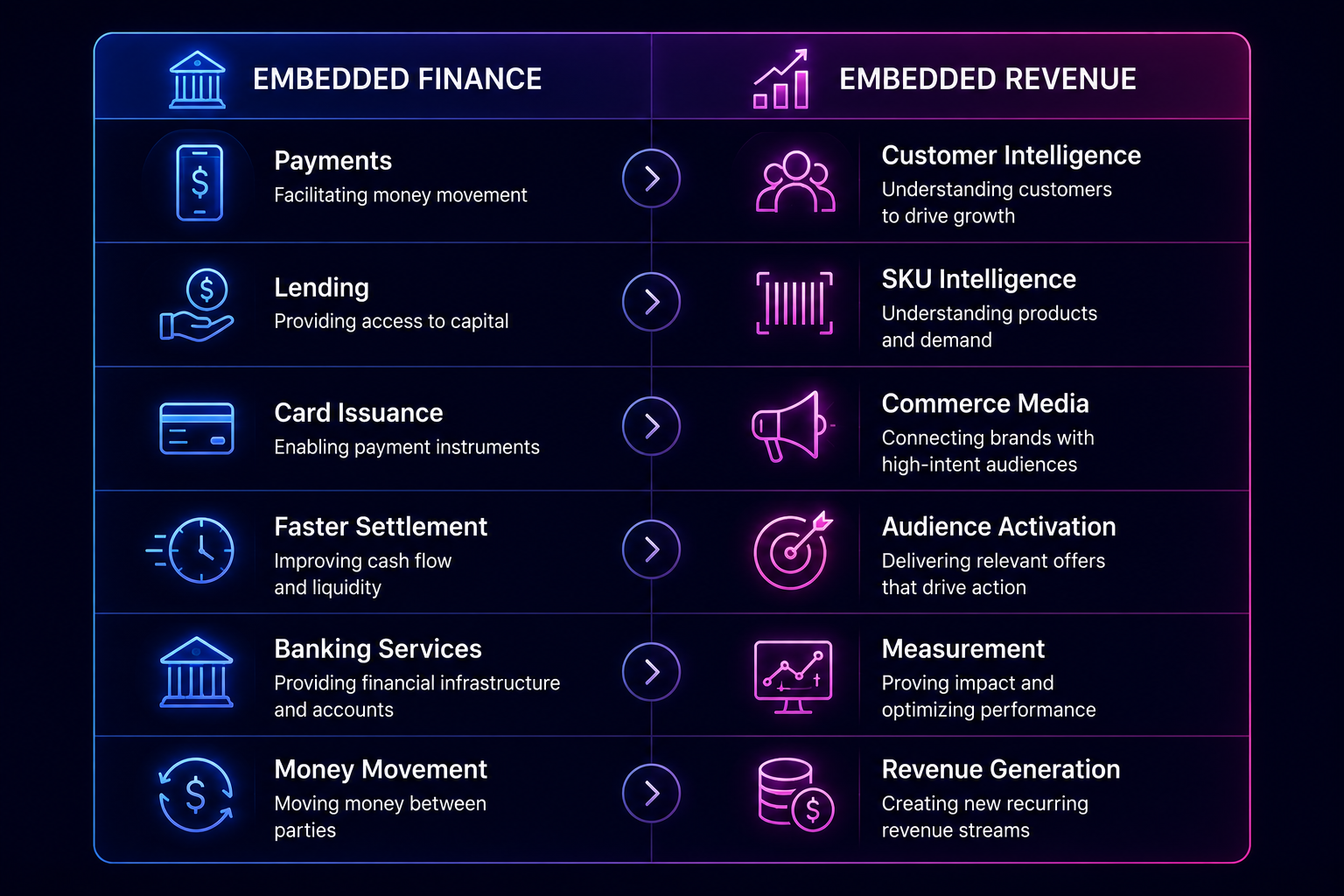
Unlike Embedded Finance, which monetizes financial products and money movement, Embedded Revenue monetizes the data, media, and intelligence created by commercial activity.
For ISVs serving SMB merchants, this represents a structural shift from selling software to participating in the economic value created within their own platforms.
Executive Takeaways
- Software platforms are evolving from systems of record into systems of intelligence, creating opportunities to monetize commercial activity without introducing new operational friction.
- Every transaction generates valuable commerce signals, but raw transaction data alone is insufficient. Standardization, enrichment, and activation transform operational data into strategic intelligence.
- Embedded Revenue extends beyond payments, encompassing customer intelligence, commerce media, AI-driven insights, measurement, benchmarking, and new platform services.
- The next generation of software leaders will create value not only by enabling commerce, but by activating the intelligence commerce generates.
The Platform Paradigm Shift
From Selling Software to Monetizing Commerce Intelligence
Historically, software created value by digitizing business processes.
Accounting software managed financial records. POS software processed transactions. Inventory software tracked products. CRM software organized customer information.
Revenue was generated primarily through software subscriptions.
Today, software has become something fundamentally different.
For millions of SMBs, software is the operational nervous system through which business is conducted. It orchestrates customer interactions, inventory management, payments, loyalty, ordering, fulfillment, and marketing.
As software increasingly becomes the operating layer of commerce, every workflow creates commercial intelligence.
This changes the economic model.
The greatest opportunity is no longer adding another software module. It is activating the intelligence already flowing through existing workflows.
This is the foundation of Embedded Revenue.
Exhibit 1
The Evolution of Platform Value
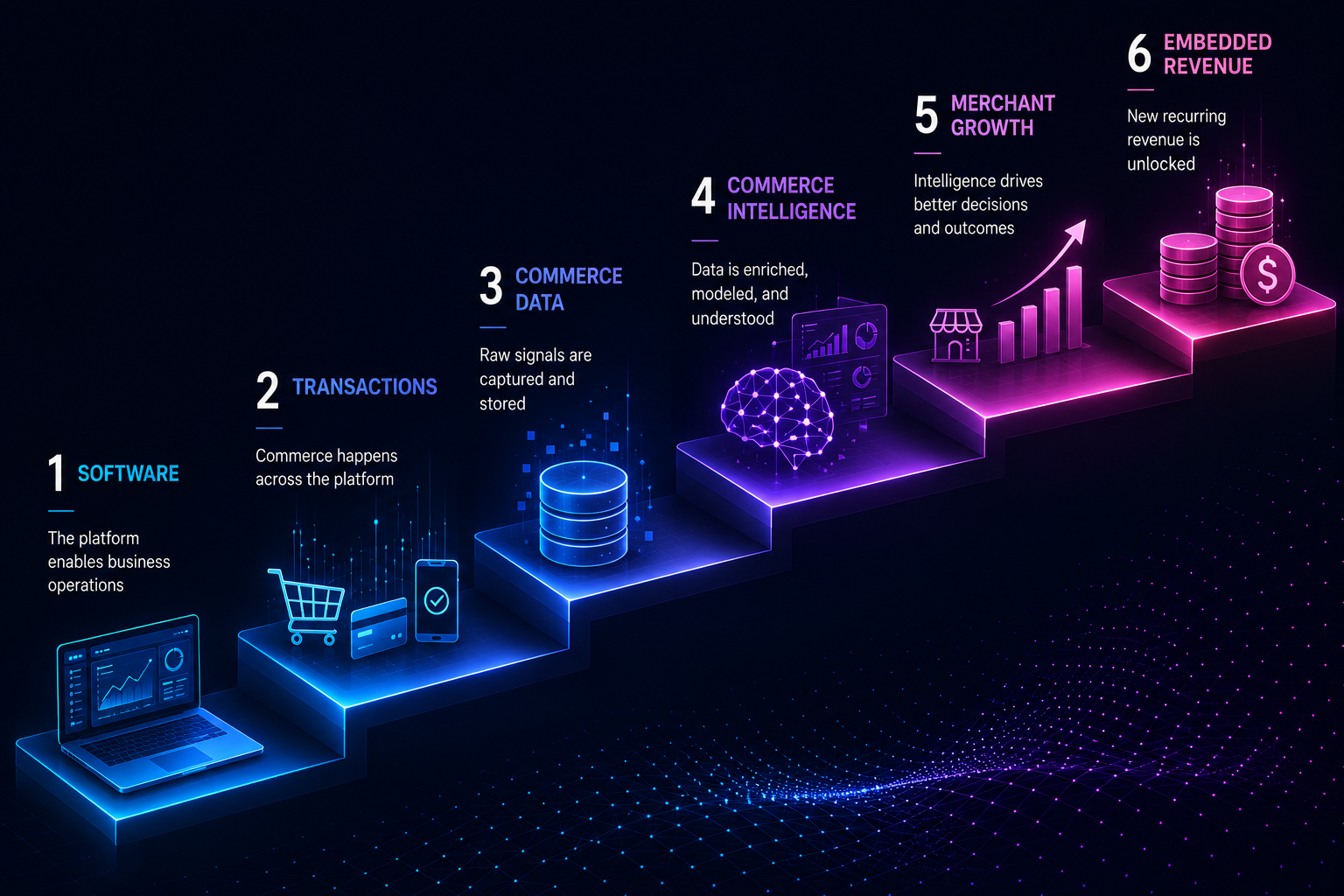
Key insight: Every transaction creates intelligence. Every intelligence signal creates an opportunity for additional value.
The Three Structural Pillars of Embedded Revenue
Embedded Revenue creates value through three complementary mechanisms. Each addresses a different dimension of platform economics while reinforcing long-term merchant success.
Pillar 1
Commerce Intelligence Begins with Transactions
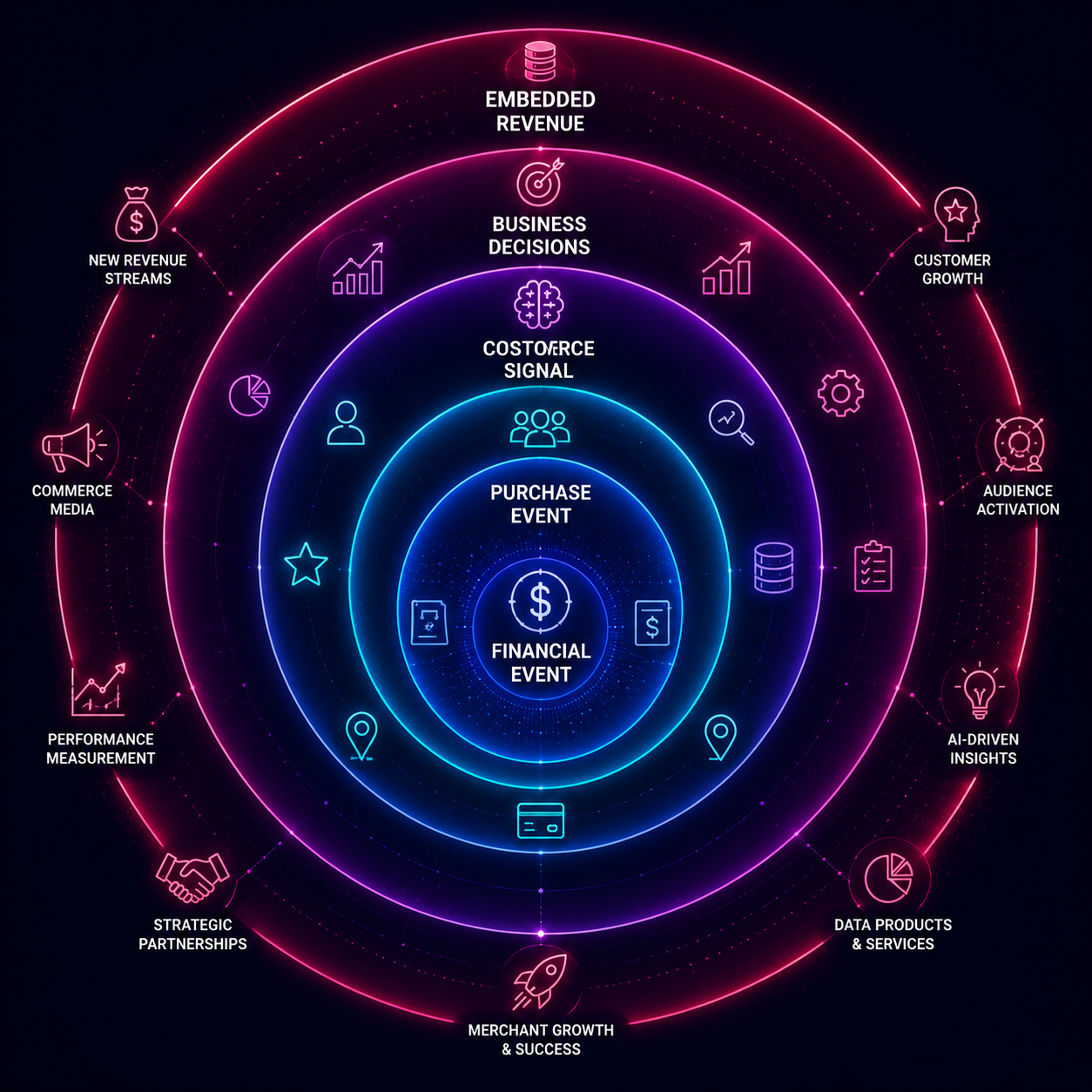
Every commercial transaction captures significantly more than a financial event. It records:
- products purchased
- purchase timing
- basket composition
- customer frequency
- brand preference
- seasonal demand
- operational performance
Collectively, these signals describe how commerce actually occurs.
Yet within many software platforms, this information remains largely underutilized. The transaction becomes a receipt. A settlement record. A reconciliation event. Its broader strategic value is often left unrealized.
The opportunity begins by recognizing that transactions are not simply operational artifacts—they are the raw material from which commerce intelligence is created.
For SMB-focused ISVs, this represents an opportunity to deliver capabilities that have historically been available only to large enterprises.
Exhibit 2
Every Transaction Generates Multiple Layers of Value
Pillar 2
Transforming Data into Merchant Intelligence
Possessing transaction data does not necessarily create intelligence.
Many SMB merchants already collect SKU-level transaction data. However, raw SKU data frequently suffers from inconsistent naming conventions, duplicate entries, incomplete product descriptions, and fragmented taxonomies.
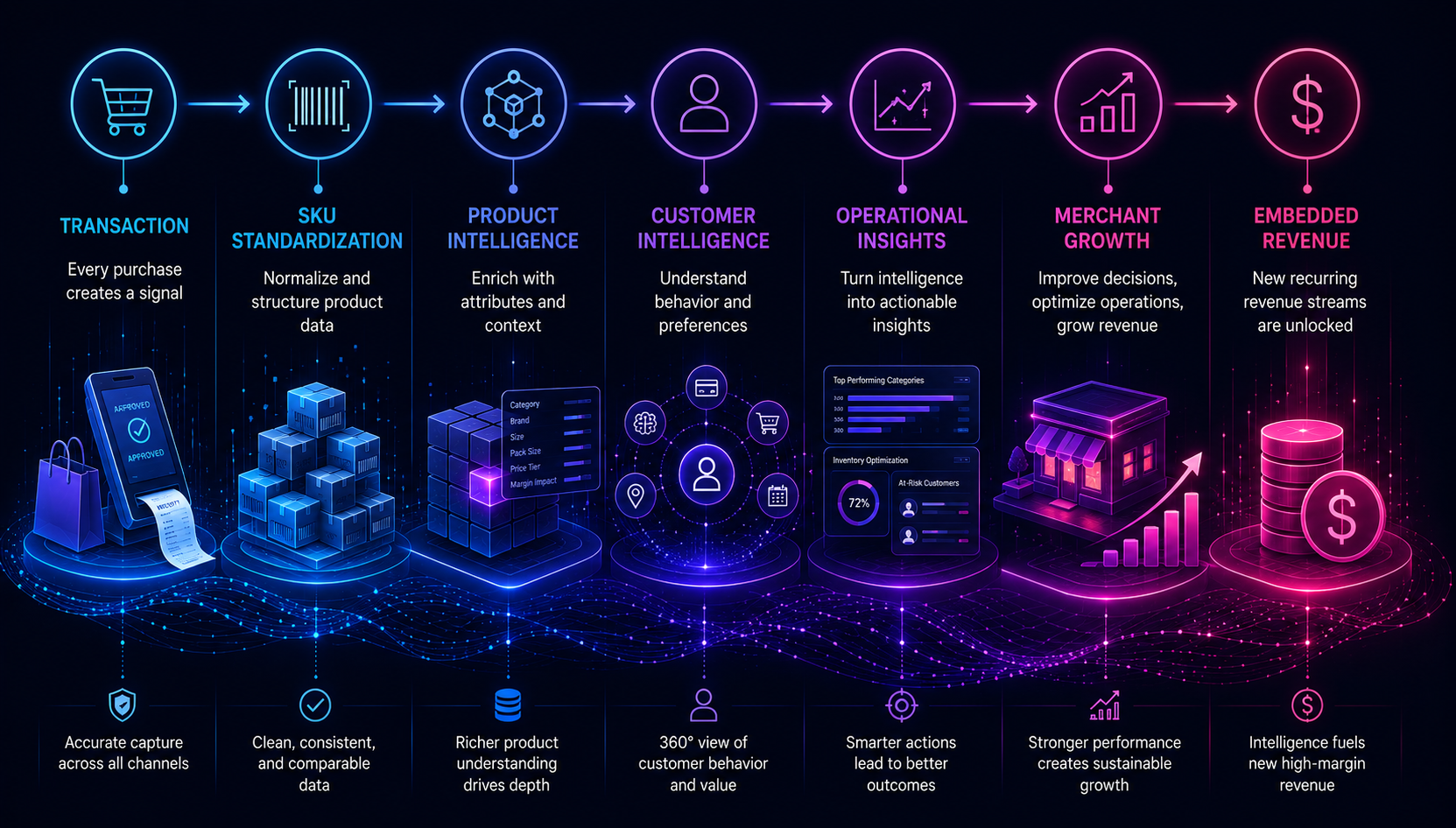
Poor data quality limits downstream analytics. Consequently, the value of commerce intelligence depends on three sequential capabilities.
Standardization
Normalize product names, UPCs, brands, categories, and product hierarchies.
Enrichment
Add contextual signals such as:
- purchase frequency
- basket composition
- customer recency
- product attributes
- geographic trends
- behavioral patterns
Activation
Translate insights into actions that improve merchant outcomes. Examples include:
- inventory optimization
- customer segmentation
- personalized offers
- operational recommendations
- supplier insights
- predictive purchasing models
The objective is not simply improving reporting. It is improving decision quality.
Exhibit 3
From Transaction Data to Merchant Intelligence
Pillar 3
Creating New Revenue from Existing Commerce
The defining characteristic of Embedded Revenue is that it creates entirely new sources of value without requiring merchants to fundamentally change how they operate.
Rather than introducing additional products, software platforms activate intelligence already generated through daily commerce.
Potential monetization opportunities include:
Commerce Media
Connecting brands with high-intent audiences based on verified purchasing behavior.
Customer Intelligence
Providing merchants with actionable insights regarding purchasing patterns, loyalty, and customer growth.
Measurement
Helping merchants and partners understand which initiatives drive measurable business outcomes.
Merchant Benchmarking
Delivering comparative insights that help SMBs evaluate performance relative to peers while preserving privacy.
AI-Driven Recommendations
Transforming commerce intelligence into personalized operational guidance.
Data Products
Creating privacy-first intelligence services that support suppliers, brands, and ecosystem partners.
Each represents a recurring value-added service rather than an additional software license.
Exhibit 4
Embedded Finance vs. Embedded Revenue
The Value Leakage of Inaction
Organizations that continue operating exclusively as subscription software providers increasingly risk allowing the economic value created within their own platforms to accrue elsewhere.
Payments generate revenue for payment providers. Commerce intelligence benefits external analytics platforms. Customer data informs third-party marketing ecosystems. Operational insights remain inaccessible to merchants.
The platform facilitates value creation without fully participating in it.
This represents a structural form of margin leakage.
As software becomes increasingly central to SMB operations, platforms that fail to activate transaction intelligence risk becoming systems of record while competitors evolve into systems of growth.
Exhibit 5
Where Platform Value Escapes
The Execution Roadmap
Building an Embedded Revenue Strategy
Embedded Revenue should not be viewed as a standalone product initiative. It is an enterprise capability that evolves alongside the platform.
Identify Existing Commerce Signals
Map the commercial activity already flowing through the platform: transactions, invoices, receipts, customer interactions, inventory, and product catalogs. The objective is to understand where intelligence already exists.
Build a Trusted Commerce Foundation
Prioritize SKU normalization, product taxonomy, data governance, customer identity, consent management, and quality assurance. Trusted intelligence begins with trusted data.
Enrich the Commerce Layer
Combine transaction records with additional contextual signals that improve merchant understanding while maintaining privacy and regulatory compliance.
Activate Merchant Intelligence
Focus on delivering capabilities that help merchants make better decisions: customer insights, operational recommendations, predictive analytics, personalized engagement, and commerce media participation. Merchant outcomes should remain the primary objective.
Monetize Through Ecosystem Value
Expand platform economics by enabling recurring intelligence services that create measurable value for merchants, suppliers, brands, and strategic partners. Revenue becomes the result of improving merchant success—not the objective itself.
Exhibit 6
Embedded Revenue Maturity Model
Conclusion
The economics of software platforms are evolving beyond subscriptions.
For decades, competitive differentiation centered on digitizing business processes.
The next generation of value will come from understanding the commerce those processes create.
Every transaction generates data. Every dataset contains intelligence. Every intelligence signal has the potential to improve merchant outcomes.
Embedded Revenue is the strategic framework for transforming that intelligence into recurring value.
Unlike Embedded Finance, which monetizes the movement of money, Embedded Revenue monetizes the knowledge created when commerce occurs.
For ISVs serving SMBs, this represents an opportunity to democratize capabilities that have traditionally been available only to the largest enterprises—helping merchants understand customers more deeply, optimize operations more effectively, participate in emerging commerce ecosystems, and unlock new sources of growth.
The defining question for platform leaders is therefore no longer:
"What additional products can we sell?"
It is:
"How do we create new revenue from the intelligence our platform already generates?"
That is the strategic imperative of Embedded Revenue.
Ready to activate your platform intelligence?
Our 90-day Data Evaluation reveals how Embedded Revenue can expand your platform economics — privately and structurally.