Why SKU-level data matters
The strategic foundation for AI, commerce media, and enterprise growth.

Executive summary
For decades, transaction data served a singular purpose: recording that a purchase occurred. While that has been sufficient for authorization, settlement, reconciliation, and reporting, it is increasingly insufficient for organizations competing in an AI-driven, first-party data economy.
Today's competitive advantage is no longer determined by whether an organization possesses transaction data, but by the depth and fidelity of the purchase intelligence embedded within it. SKU-level data — the detailed record of exactly what was purchased — transforms a payment event from a financial record into a strategic source of customer, operational, and commercial intelligence.
Key takeaways
- SKU-level data transforms transactions into strategic intelligence — not just what was spent, but exactly what was purchased and why it matters.
- The economic value of transaction data increasingly depends on granularity. Aggregate records enable reporting; SKU-level data enables predictive decisions.
- Media activation, operational excellence, and new monetization models all depend on product-level visibility.
- SKU intelligence is foundational infrastructure for AI, customer intelligence, and future revenue — not simply enhanced reporting.
The macro shift
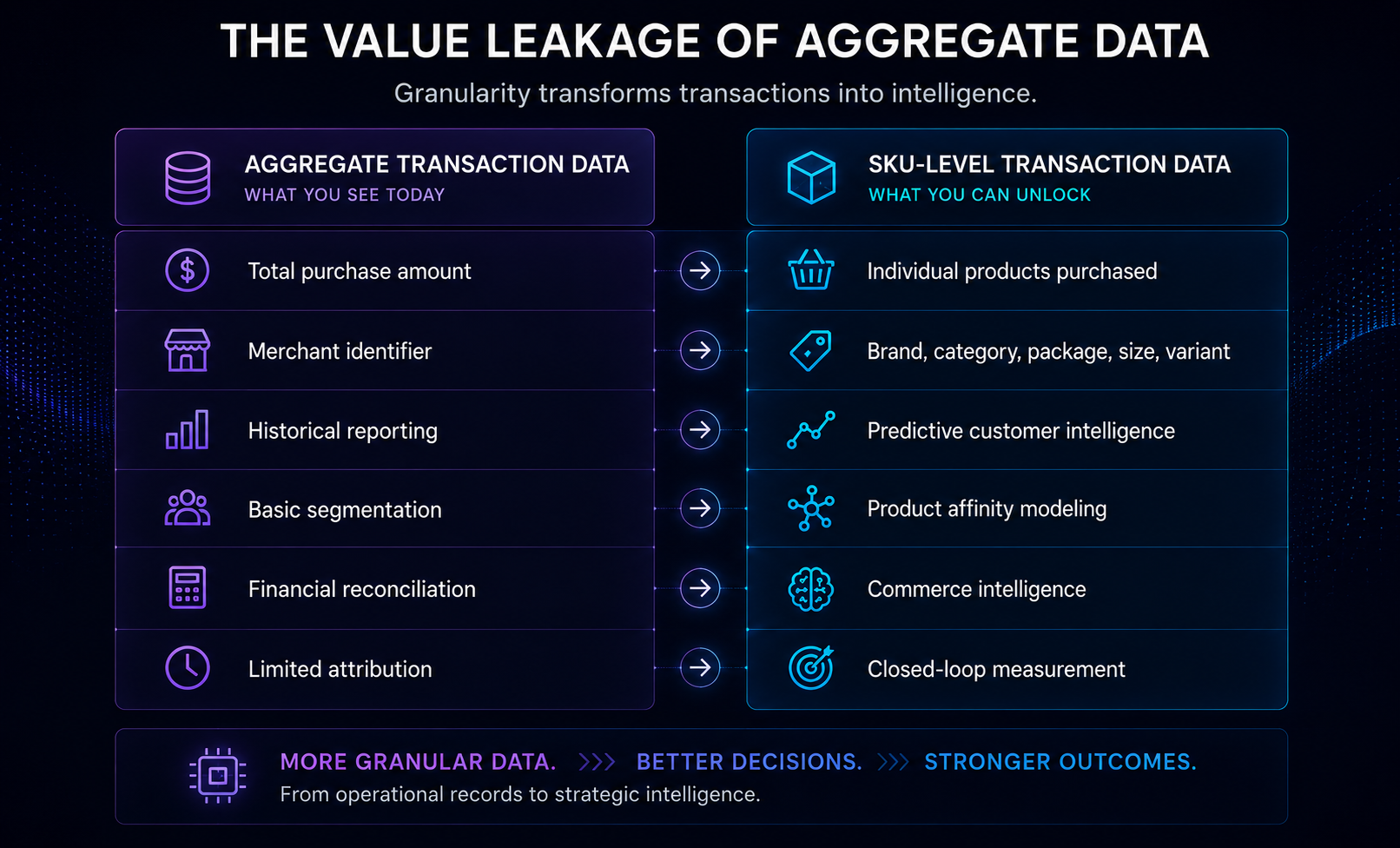
Aggregate transaction data is no longer enough
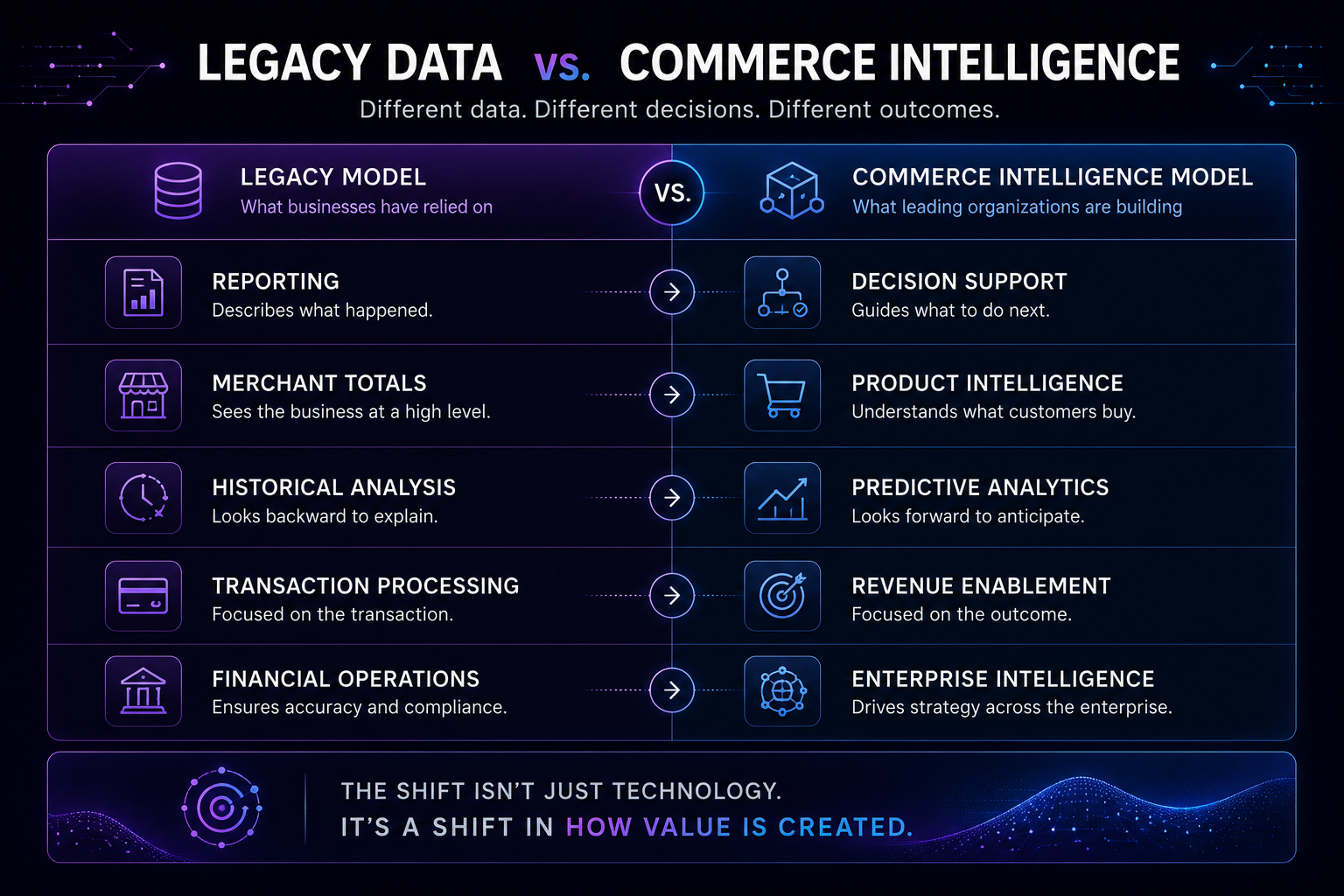
Historically, transaction systems were designed to answer operational questions: was the payment authorized, how much was spent, where did the purchase occur, was settlement completed. These remain essential — but they do little to explain customer behavior or commercial opportunity.
A transaction totaling $147.82 conveys financial value but provides limited strategic insight. Whether it reflects premium pet food, baby products, consumer electronics, or seasonal apparel fundamentally changes its business implications. Increasingly, enterprise value is created by understanding what was purchased rather than simply how much was spent.
Four structural forces driving the shift
Identity is becoming harder to infer
As browsers, operating systems, and regulators reduce reliance on third-party cookies and cross-site tracking, organizations must depend on consented first-party data. Purchase history is one of the most reliable and privacy-respecting sources of customer intent available.
Retail media is redefining marketing economics
Retail Media Networks have become one of the fastest-growing segments of digital advertising precisely because they enable brands to reach customers based on verified purchasing behavior — a capability that depends on detailed product-level transaction data, not aggregate spend.
AI requires context, not just volume
Artificial intelligence does not create intelligence from raw data alone. It requires standardized data, consistent taxonomy, contextual relationships, and historical patterns. SKU-level transaction histories provide materially richer context than merchant-level summaries.
Measurement expectations keep rising
Marketing leaders face growing pressure to demonstrate business outcomes beyond impressions and clicks. Closed-loop measurement requires connecting exposure to actual product purchases — a capability fundamentally enabled by SKU-level transaction data.
The strategic imperative
SKU-level data creates enterprise value across three distinct domains. These capabilities reinforce one another but solve different strategic challenges.

Media activation & customer intelligence
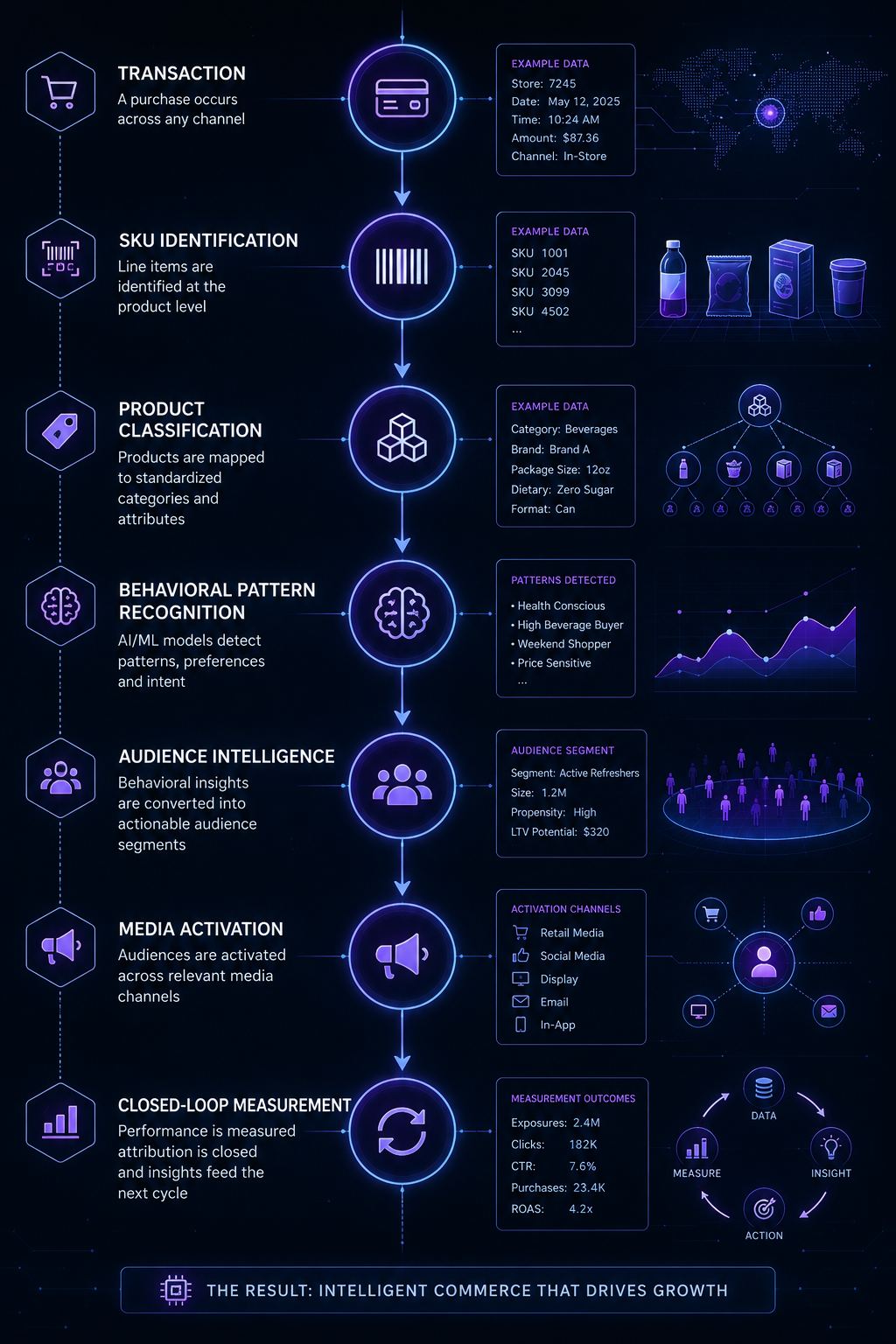
Traditional digital advertising relies on proxies — website visits, search behavior, demographic assumptions, modeled audiences. Actual purchases are a far stronger signal. Knowing a customer buys premium organic pet food every month is materially different from knowing they spent $85 at a grocer.
- Build highly relevant audience segments
- Improve personalization and suppress irrelevant advertising
- Increase customer lifetime value and campaign efficiency
- Enable closed-loop attribution to verified purchases
From purchase history to customer intelligence
Operational efficiency & inventory strategy
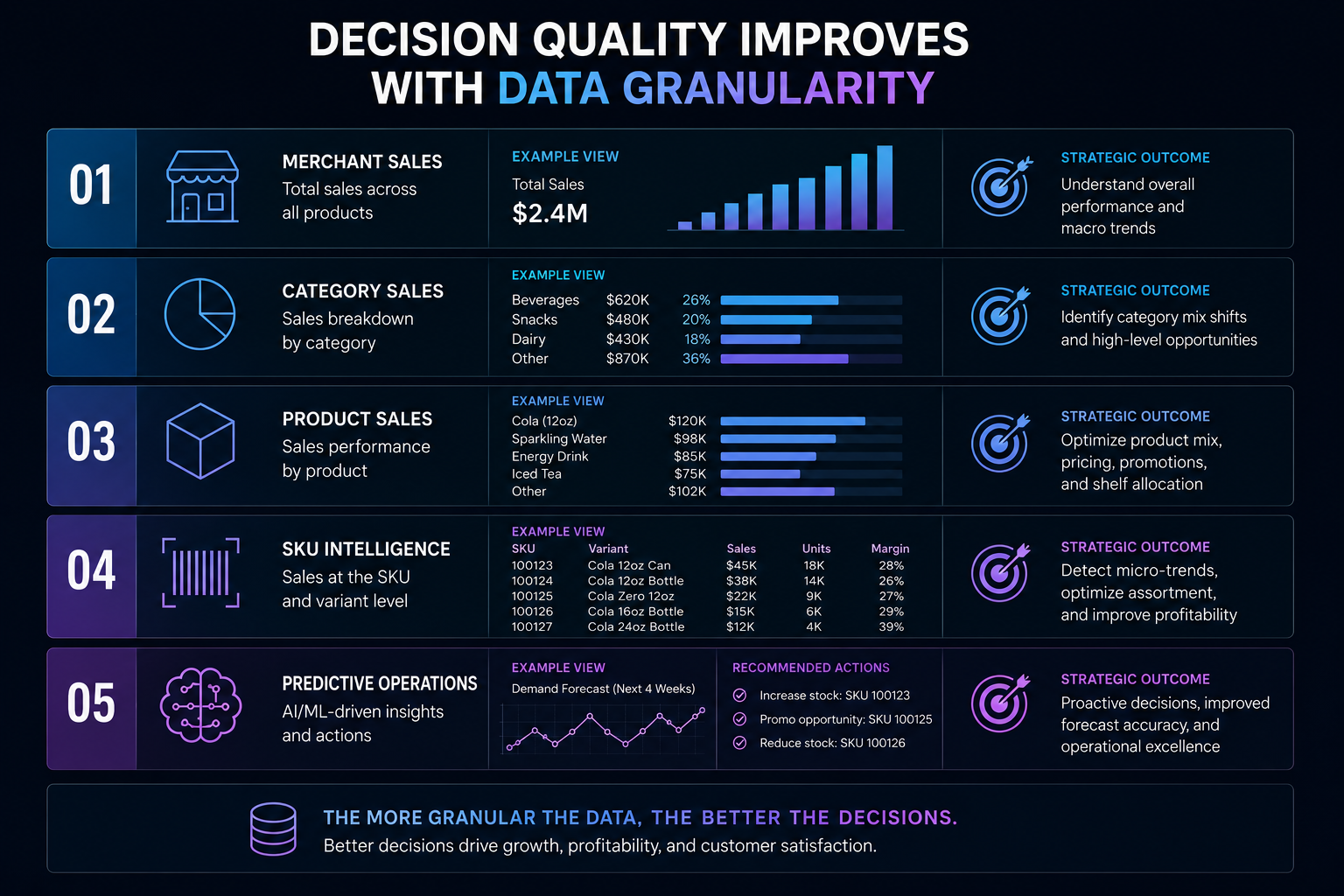
Marketing gets the attention, but operational value can be equally significant. Product-level visibility improves inventory planning, assortment optimization, demand forecasting, supplier negotiations, replenishment timing, and regional merchandising.
- Distinguish real demand shifts from inventory constraints
- Identify substitution effects before they compound
- Detect pricing and assortment gaps earlier
- Move from reactive reporting to predictive planning
Monetization pathways
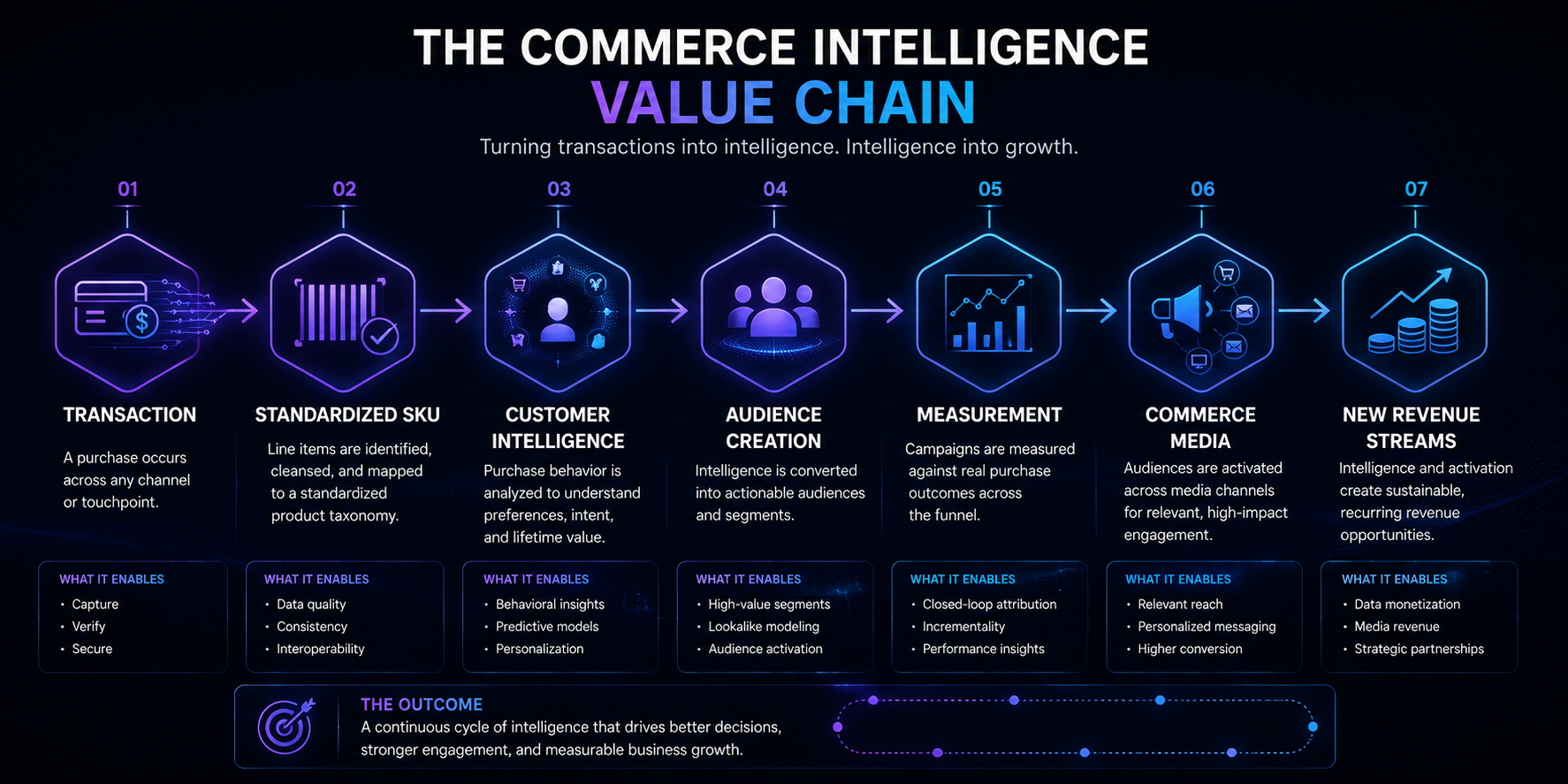
Perhaps the least understood opportunity is the potential to support entirely new business models. Historically, payment platforms generated value through processing. Increasingly, the underlying commerce intelligence itself becomes an enterprise asset.
- Commerce media: verified audiences based on real behavior
- Measurement services: link ad spend to business outcomes
- Customer intelligence products for merchants and brands
- AI applications trained on structured, real-world purchases
The cost of inaction
Organizations relying exclusively on aggregate transaction reporting face structural disadvantages that extend well beyond marketing performance.
Reduced customer understanding
Without product-level visibility, personalization becomes generalized rather than contextual.
Lower marketing efficiency
Audience construction depends on inferred behaviors instead of observed purchases.
Weaker AI performance
Models trained on incomplete commercial context generate less relevant recommendations and predictions.
Limited monetization options
Merchant-level summaries offer fewer opportunities to participate in emerging commerce media ecosystems.
Slower decision making
Teams spend more time explaining historical performance than anticipating future demand.
The way forward
Enterprise transformation rarely begins with technology alone. Organizations that successfully activate SKU-level data follow a structured progression.

Assess existing data assets
Understand transaction coverage, product-detail availability, data quality, consent framework, and integration maturity before expanding collection.
Standardize product data
Normalize UPCs, product names, brand hierarchy, category taxonomy, packaging, sizing, and manufacturer relationships. Without standardization, scale is difficult to achieve.
Build a unified commerce data foundation
Integrate transaction systems, loyalty, customer identity, product catalog, media platforms, and analytics into a common operating model across commercial functions.
Activate high-value use cases
Prioritize personalized engagement, closed-loop measurement, demand forecasting, assortment optimization, commerce media activation, and CLV modeling.
Establish continuous governance
Treat commerce intelligence as a strategic capability. Govern data quality, privacy, consent, taxonomy, model performance, and organizational ownership on an ongoing basis.
Enterprise SKU intelligence maturity model
Conclusion
The strategic value of transaction data is undergoing a fundamental redefinition. Where organizations once viewed payment records primarily as operational artifacts, leading enterprises increasingly recognize them as sources of commerce intelligence capable of informing customer engagement, operational excellence, and new business models.
SKU-level data is not simply a more detailed reporting layer. It is the connective tissue between transactions, customer understanding, AI, measurement, and monetization. As first-party data becomes more valuable, AI becomes more pervasive, and commerce media matures, organizations with trusted, standardized SKU-level intelligence will be better positioned to adapt and unlock new sources of enterprise value.
The question facing executive teams is no longer whether SKU-level data matters, but how quickly they can transform it into a strategic capability.
Ready to turn transactions into commerce intelligence?
Our 90-day Data Evaluation quantifies the SKU intelligence hiding in your existing payment, receipt, and identity data — privately and structurally.