Retailer data alone is incomplete
Cross-merchant payment signal reveals the full shopper — the missing half of commerce intelligence.
Executive summary
The commerce industry is producing more transaction data than ever before, yet many organizations struggle to convert that information into meaningful customer intelligence.
For SMB merchants, the challenge is particularly acute. Unlike large retailers operating sophisticated Retail Media Networks, most SMBs lack dedicated data science teams, standardized product catalogs, identity infrastructure, and customer intelligence platforms.
Even when detailed transaction data exists, it is often fragmented across payment systems, point-of-sale software, loyalty platforms, ecommerce channels, and accounting systems.
Compounding this challenge, SKU-level data itself is rarely standardized. Product descriptions are frequently entered manually, resulting in inconsistent naming conventions, duplicate products, incomplete descriptions, and missing product attributes.
Consequently, organizations often possess thousands—or millions—of transaction records without a reliable understanding of what customers actually purchase.
The strategic opportunity is therefore not simply collecting more data. It is creating trusted commerce intelligence through standardized, enriched, and connected transaction data.
Executive takeaways
- SKU-level transaction data is foundational, but raw SKU data alone rarely delivers enterprise intelligence.
- Product standardization and data enrichment significantly improve the quality of customer insights.
- Individual merchant data provides valuable visibility into one business but remains incomplete without broader commerce context.
- Future competitive advantage will depend on transforming fragmented transaction records into unified customer intelligence.
The strategic friction
More data does not necessarily create better intelligence
One of the persistent misconceptions in commerce is that collecting more transaction data naturally produces better business decisions. In practice, the opposite is often true.
Poor-quality data tends to amplify downstream challenges. Manual product entry, inconsistent naming conventions, duplicate SKUs, abbreviated descriptions, and missing product attributes create ambiguity long before analytics begin.
For example, the following product descriptions may represent the same item:
To a merchant, these may appear as six different products. To a customer, they represent one purchasing behavior. Without normalization, organizations are not measuring customer demand—they are measuring inconsistencies in product data.
The Data Quality Pyramid
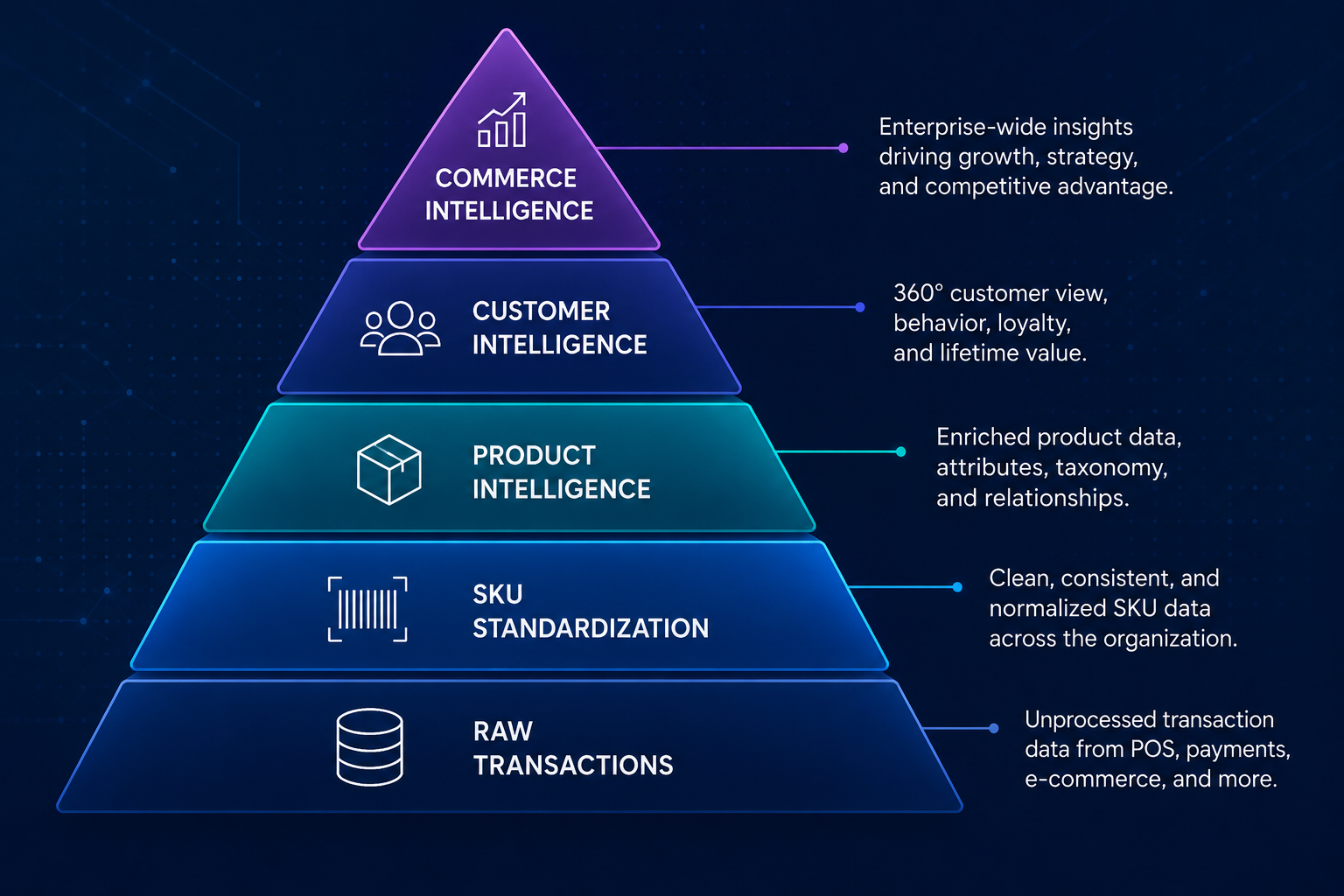
Key insight: Intelligence quality cannot exceed data quality.
Data standardization: turning transactions into trusted intelligence
Many organizations believe they possess SKU-level intelligence simply because line-item data exists within their POS system. However, transaction records and standardized product intelligence are fundamentally different assets.
High-quality commerce intelligence requires:
- Normalized product names
- Standardized UPC mappings
- Consistent brand hierarchies
- Product taxonomy
- Package normalization
- Category classification
Only after these foundations exist can organizations accurately answer questions such as:
- Which brands drive repeat purchases?
- Which products are frequently purchased together?
- Which customer segments exhibit similar purchasing behaviors?
Raw SKU data vs. commerce intelligence
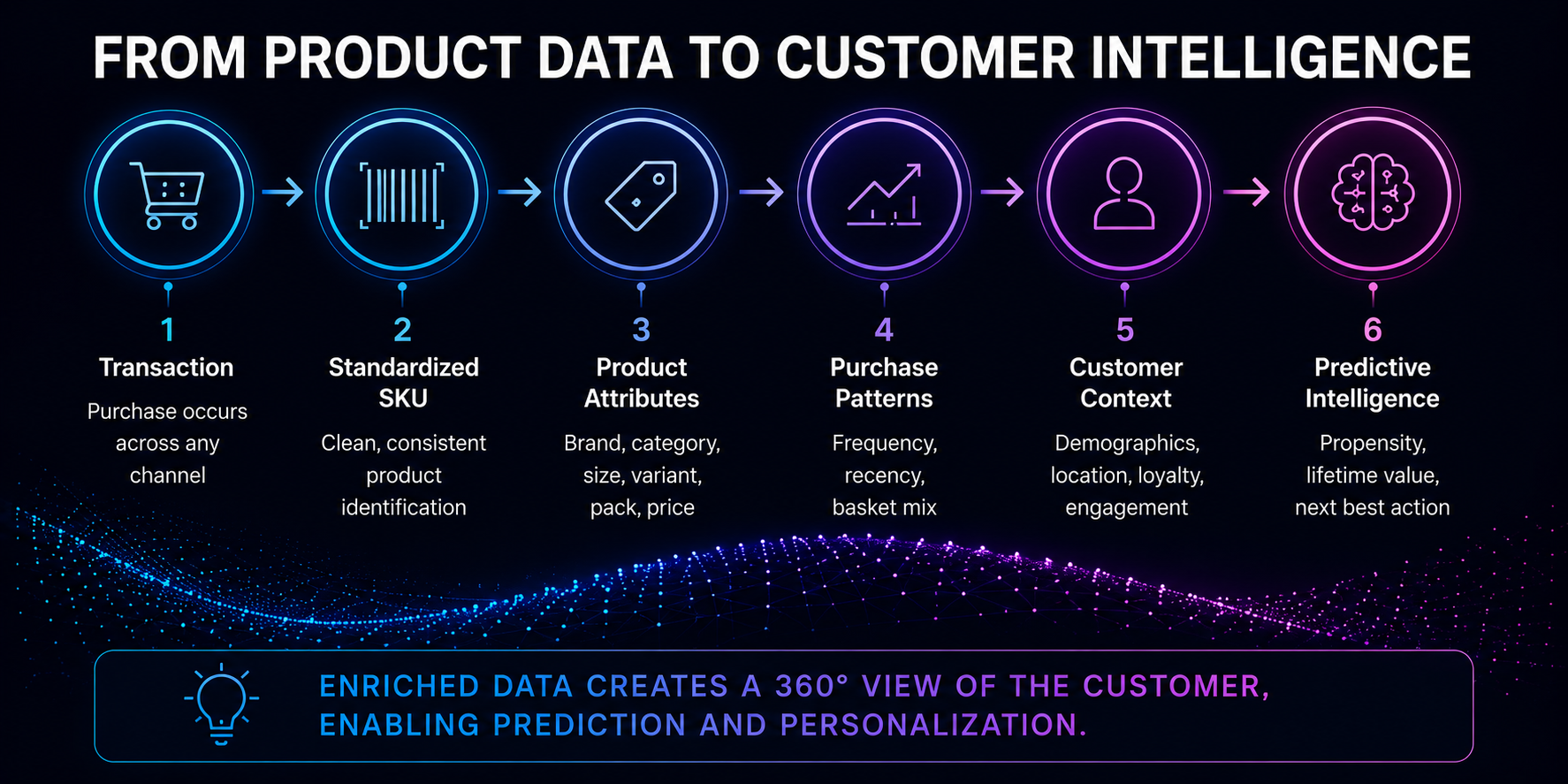
Data enrichment: understanding customers beyond products
Even perfectly standardized SKU data tells only part of the story. Knowing what customers purchase is valuable. Understanding who purchases those products, when they purchase them, how frequently they return, and what broader behavioral patterns exist creates substantially greater strategic value.
Data enrichment combines transaction histories with additional privacy-first signals, including:
- Customer purchase frequency
- Visit recency
- Basket composition
- Geographic context
- Seasonal purchasing behavior
- Demographic characteristics (where appropriate and consented)
- Product affinities
- Customer lifetime value
- Household purchasing patterns
The objective is not to collect more personal information. It is to add business context that transforms transactions into customer intelligence.
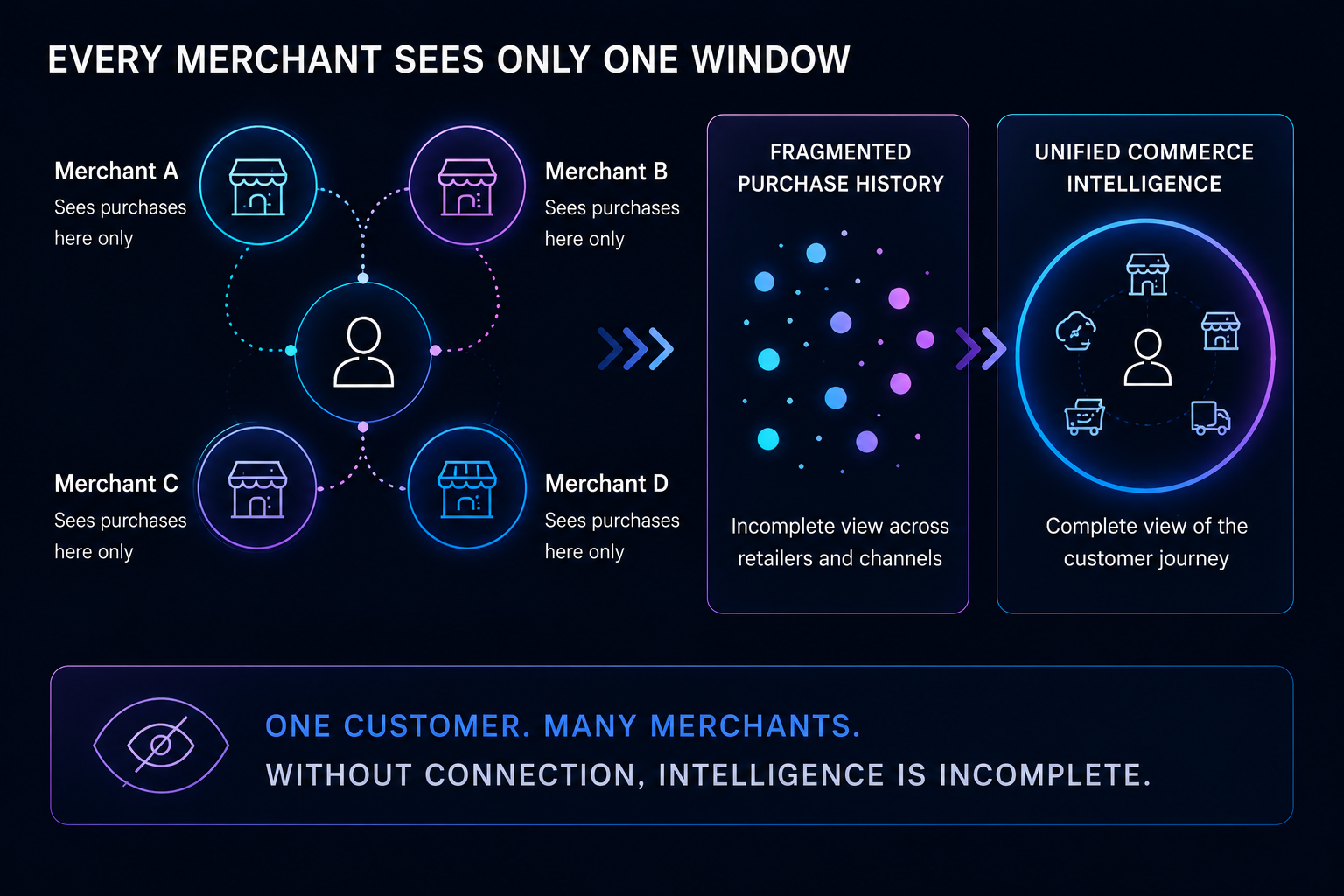
Commerce context: every merchant sees only part of the customer journey
Perhaps the greatest limitation facing SMB merchants is not poor analytics—it is incomplete visibility. A merchant knows what customers purchase in their own store. They rarely know:
- What customers purchase elsewhere
- How spending shifts between merchants
- Category purchasing outside their business
- Competitive shopping behavior
- Total wallet share
Consequently, even the most sophisticated merchant analytics describe only one chapter of the customer's purchasing journey.
Commerce intelligence becomes significantly more valuable when viewed across a broader ecosystem while maintaining privacy and customer consent. Payment infrastructure, standardized transaction frameworks, and privacy-first commerce networks have the potential to provide a richer understanding of purchasing behavior than any single merchant could develop independently.
The macro shift
From merchant data to commerce intelligence
The next evolution is not collecting more merchant data. It is connecting high-quality commerce data.
Historically, organizations asked: What happened inside my business?
Increasingly, they ask:
- How do my customers shop?
- What products drive loyalty?
- Which categories predict future purchases?
- How can AI personalize experiences?
- Where are revenue opportunities being missed?
These questions require more than transaction records. They require trusted commerce intelligence.
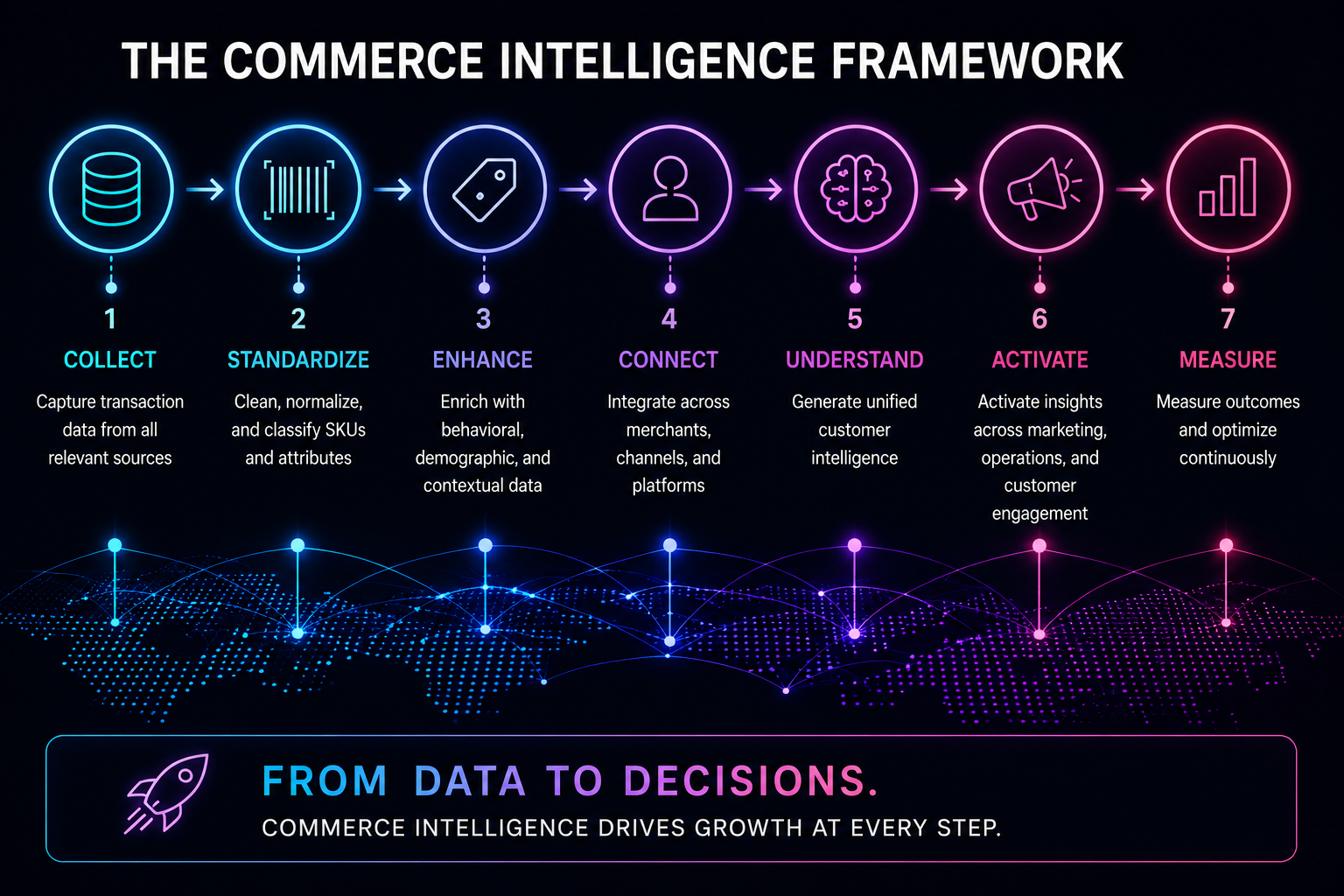
The C-suite mandate
The strategic question is no longer whether organizations possess enough data. Most already do. The question is whether that data can be trusted, enriched, connected, and activated.
For executive teams, five priorities emerge:
Standardize first
Normalize SKU data before investing in advanced analytics or AI.
Enrich responsibly
Add contextual signals—behavioral, geographic, demographic (where appropriate), and product attributes—to make transaction data more meaningful.
Break down silos
Integrate POS, payments, loyalty, ecommerce, and CRM data to create a unified customer view within the business.
Expand perspective
Where privacy and partnerships allow, complement merchant data with broader commerce intelligence to understand purchasing beyond a single storefront.
Activate continuously
Use trusted commerce intelligence to improve personalization, inventory decisions, customer engagement, measurement, and new revenue opportunities.
Ready to see the full picture?
Our 90-day Data Evaluation reveals how cross-merchant signal can complement your existing data assets — privately and structurally.