The Hidden Ledger
Where software companies are unknowingly leaving value on the table—and how to identify it.
Why the Next Generation of Platform Value Will Come From Commerce Intelligence, Not Software Alone
Executive Summary
Software platforms process billions of commercial events every day. Invoices are generated. Payments are accepted. Products are purchased. Receipts are issued. Customers return. Inventory moves.
These activities power the modern SMB economy. Yet most software platforms monetize only one layer of this activity: the software subscription. Some participate in payment processing. A smaller number monetize embedded financial services. Very few activate the broader intelligence created by commerce itself.
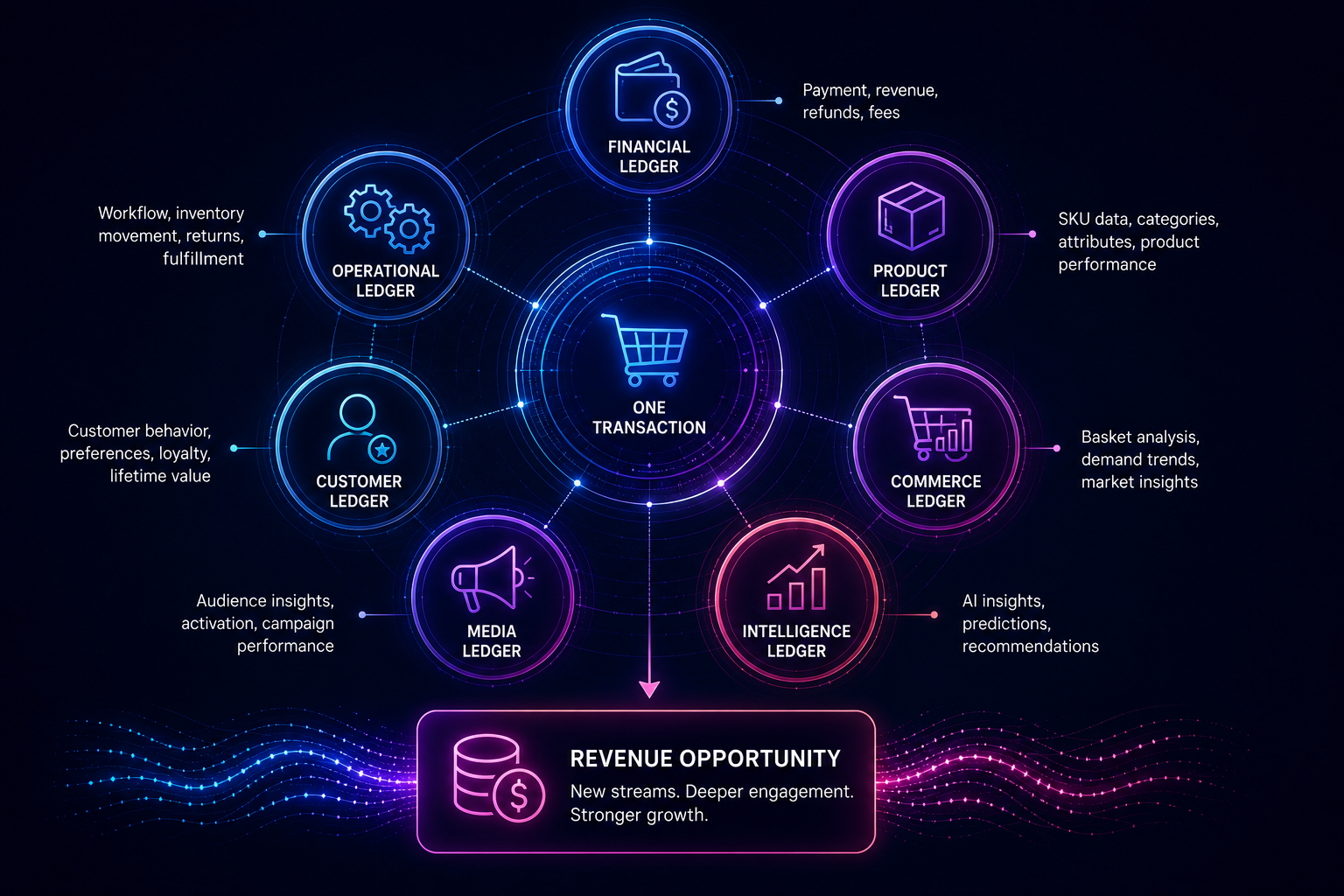
Every transaction simultaneously generates multiple forms of value: a financial event, an operational event, a product event, a customer event, a behavioral event, a commerce event.
Collectively, these signals form what can be described as the Hidden Ledger—the layer of intelligence created by every transaction that remains largely invisible within traditional software business models.
Historically, this ledger has been treated as operational exhaust. Increasingly, it is becoming one of the most valuable assets a platform possesses.
The next generation of software leaders will compete not simply by building better applications, but by activating the intelligence already flowing through their platforms.
Executive Takeaways
- Software platforms typically monetize only one layer of commercial activity while multiple additional value layers remain untapped.
- Commerce intelligence increasingly represents a recurring revenue opportunity that extends well beyond software subscriptions and payment processing.
- Standardized transaction and SKU intelligence create the foundation for merchant insights, AI-driven recommendations, commerce media, and new platform services.
- Competitive advantage will increasingly belong to platforms that recognize transaction intelligence as an enterprise asset rather than an operational byproduct.
The Diagnosis of Invisible Leakage
Software Platforms Measure Revenue. They Rarely Measure Value.
For decades, software executives have optimized around familiar metrics: ARR, MRR, Customer Acquisition Cost, Net Revenue Retention, Gross Margin, and Churn. These remain essential indicators of business health.
Yet they measure only the economics of the software itself. They reveal remarkably little about the economic value created inside the platform.
Every commercial workflow generates intelligence. Most executive dashboards ignore it.
Consider a typical transaction. A payment is processed. The merchant records a sale. Revenue is recognized. The transaction disappears into history.
What is rarely considered is everything else that transaction reveals: products purchased, customer preferences, buying frequency, basket composition, purchasing trends, seasonal behavior, operational efficiency, and future demand signals.
Most organizations store this information. Few transform it into recurring enterprise value. The result is not simply underutilized data. It is structural margin leakage.
Exhibit 1
The Hidden Ledger of Every Transaction
The Three Hidden Revenue Vectors
Every transaction creates multiple opportunities for platform expansion. Most organizations activate only one.
Pillar 1
The Transaction Layer
For many software platforms, transaction monetization begins and ends with payment processing. Revenue is generated through payment acceptance, transaction fees, settlement, and billing.
These capabilities remain valuable. However, they represent only the financial layer of commerce.
Forward-looking platforms increasingly expand participation through services such as embedded invoicing, recurring billing, merchant financing, accelerated settlement, expense management, working capital, and payment optimization.
Each increases revenue while reducing merchant friction. Yet even these capabilities monetize the movement of money. They do not monetize the intelligence created when money moves. That distinction defines the next phase of platform economics.
Exhibit 2
One Transaction. Multiple Sources of Enterprise Value.
| Layer | Traditional View | Emerging Opportunity |
|---|---|---|
| Payment | Transaction fee | Embedded financial services |
| Operations | Accounting record | Workflow optimization |
| Products | SKU history | Product intelligence |
| Customer | Purchase record | Customer intelligence |
| Commerce | Historical reporting | Predictive commerce intelligence |
| Platform | Subscription | Embedded Revenue |
Pillar 2
The Commerce Intelligence Ledger
Every transaction tells a story. Most platforms record the ending. Very few understand the narrative.
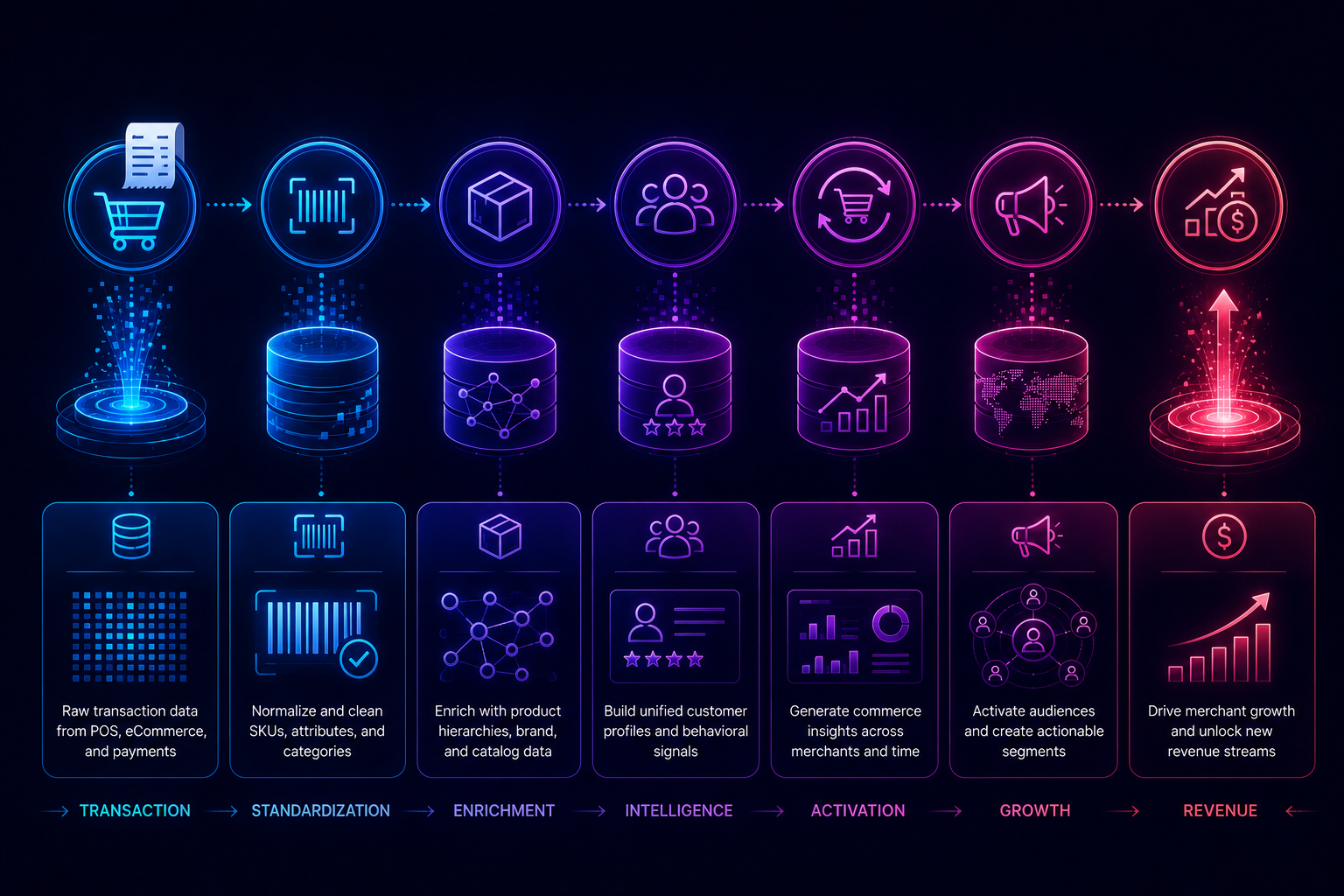
Raw transaction records rarely create competitive advantage. Commerce intelligence emerges only after information is standardized, enriched, connected, and interpreted.
Consider a simple purchase. Without context: Customer spent $84. With standardized commerce intelligence: premium pet owner, repeat customer, high-margin category, increasing basket value, likely replenishment within three weeks, candidate for personalized engagement.
The transaction itself has not changed. Only the quality of intelligence has changed.
This distinction becomes particularly important for SMB merchants. Unlike large retailers, most SMBs lack dedicated analytics teams, sophisticated customer intelligence platforms, or Retail Media Networks. Software platforms have an opportunity to democratize these capabilities by transforming fragmented transaction records into actionable merchant intelligence.
SKU-level transaction data provides the foundation. Product normalization creates consistency. Data enrichment adds context. Cross-merchant intelligence broadens perspective. Together, these capabilities create a fundamentally different understanding of commerce.
Exhibit 3
From Raw Transactions to Commerce Intelligence
Pillar 3
The Intelligence Services Layer
The final—and often least recognized—revenue opportunity lies in transforming commerce intelligence into recurring platform services. Historically, software vendors sold features. Increasingly, they can deliver intelligence.
Merchant Benchmarking
How does this merchant compare with similar businesses?
Customer Intelligence
Which customers are becoming less engaged? Which products create long-term loyalty?
Predictive Inventory
Which products are likely to experience increasing demand?
Supplier Intelligence
Which brands outperform regional averages?
Commerce Media
How can suppliers and brands reach verified purchase audiences?
AI Recommendations
Which actions are most likely to improve merchant performance?
These services are fundamentally different from software modules. They improve decision quality rather than operational efficiency. They become increasingly valuable as data quality improves.
Exhibit 4
The Intelligence Services Portfolio
| Intelligence Asset | Merchant Value | Platform Opportunity |
|---|---|---|
| Customer Intelligence | Better retention | Premium analytics |
| Product Intelligence | Smarter inventory | Benchmarking |
| Commerce Intelligence | Better decisions | Data products |
| Audience Intelligence | Personalized engagement | Commerce media |
| Measurement | Improved marketing ROI | Attribution services |
| AI Recommendations | Operational optimization | Subscription intelligence |
The Strategic Cost of Inertia
Organizations that continue measuring platform success exclusively through subscription growth risk overlooking a broader transformation occurring within software economics.
Increasingly, enterprise valuation reflects not only recurring software revenue, but also participation in Gross Transaction Value (GTV), embedded financial services, and recurring intelligence products.
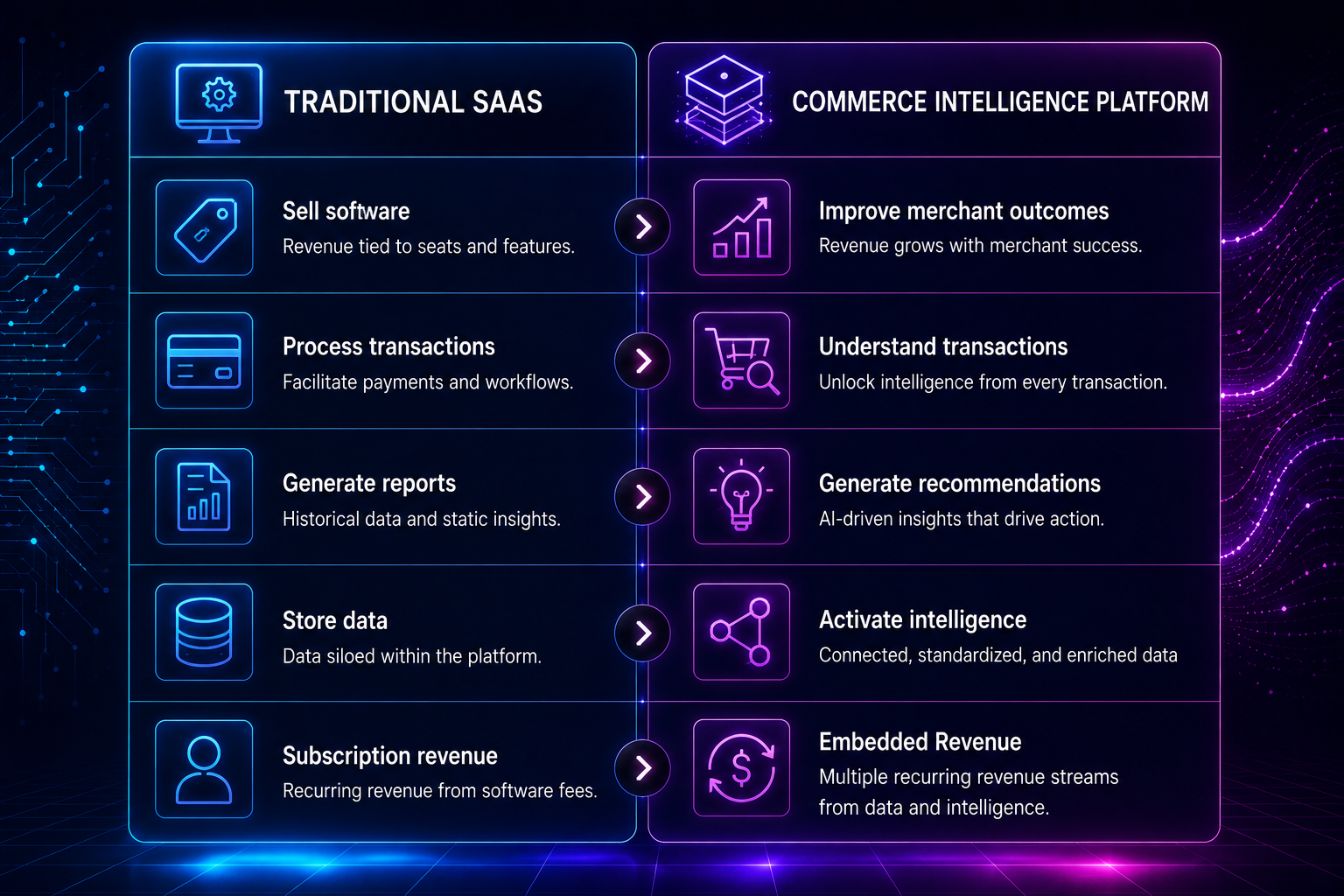
The distinction is significant. One platform monetizes access. The other monetizes outcomes.
As platforms mature, recurring intelligence services can strengthen Net Revenue Retention, merchant engagement, customer lifetime value, revenue diversification, capital efficiency, and platform defensibility.
The result is a business model that scales through merchant success rather than software expansion alone.
Exhibit 5
From Software Company to Commerce Intelligence Platform
The Monetization Audit Checklist
Executive teams should periodically evaluate whether their platform captures the full economic value of the commerce it enables. Five questions provide a practical starting point.
- 1Which commercial workflows already occur inside our platform?
- 2Which transaction signals are we collecting but not activating?
- 3Is our SKU and product data standardized sufficiently to support advanced intelligence?
- 4Which recurring merchant decisions could be improved through AI and commerce intelligence?
- 5Which new recurring revenue services could emerge from the intelligence our platform already generates?
These questions shift executive thinking from feature expansion toward value expansion.
Exhibit 6
The Hidden Ledger Maturity Model
| Stage | Primary Capability | Enterprise Outcome |
|---|---|---|
| Capture | Collect transactions | Operational visibility |
| Standardize | Normalize products and commerce data | Trusted foundation |
| Interpret | Generate customer and commerce intelligence | Better decisions |
| Activate | Deliver merchant insights | Merchant growth |
| Monetize | Create recurring intelligence services | Sustainable Embedded Revenue |
Conclusion
For decades, software companies have measured success by the number of customers they acquire, the subscriptions they renew, and the features they deliver. These metrics remain important. They are no longer sufficient.
Every transaction contains multiple layers of value. Some are financial. Some are operational. Increasingly, the most valuable are informational.
The Hidden Ledger is the collection of commerce intelligence created by every transaction—an asset that most platforms already possess but few fully activate.
The future of platform economics will not be defined solely by software subscriptions or embedded financial services. It will be defined by the ability to transform commerce intelligence into measurable merchant outcomes and recurring revenue.
The defining question for executive teams is therefore no longer:
"How can we sell more software?"
It is:
"How much value is already flowing through our platform that we have yet to recognize?"
The organizations that answer that question first will be the ones that redefine the economics of software for the next decade.