The Payments-to-Media Gateway
Why the Next Decade of Platform Growth Will Be Driven by Commerce Intelligence
A market perspective on the structural convergence of payments, commerce data, artificial intelligence, and media.
Executive Summary
Commerce has entered a new phase of value creation.
The first wave digitized transactions. The second embedded financial services into software platforms. The third is now emerging: transforming transaction intelligence into recurring data, media, and commerce revenue.
This transition is not being driven by a single technology or market participant. It reflects the convergence of several structural trends reshaping commerce simultaneously:
- Payment processing margins continue to compress as acquiring becomes commoditized.
- Retail Media Networks have become one of the fastest-growing segments in advertising, demonstrating the commercial value of first-party purchase intelligence.
- Artificial intelligence is increasing the strategic importance of structured, high-fidelity commerce data.
- Third-party identifiers continue to lose effectiveness, elevating the value of consented first-party transaction data.
- Software platforms have become the operational infrastructure through which millions of SMB transactions already occur.
Collectively, these shifts are redefining the strategic role of the transaction. No longer simply a financial event, the transaction is becoming the gateway through which commerce intelligence is captured, enriched, activated, and monetized.
This evolution represents far more than another revenue opportunity for software platforms. It signals a broader reallocation of value across the commerce ecosystem, where competitive advantage increasingly depends not on processing payments more efficiently, but on understanding commerce more intelligently.
Executive Takeaways
- Commerce intelligence is emerging as the next structural layer of platform economics, extending well beyond payment processing and software subscriptions.
- Large retailers proved the commercial value of transaction intelligence through Retail Media Networks; the SMB ecosystem is now approaching a comparable inflection point through software platforms.
- ISVs increasingly occupy the strategic position once held exclusively by enterprise retailers — the operating infrastructure capable of aggregating, standardizing, and activating fragmented commerce data at scale.
- Platforms that transform transactions into intelligence — and intelligence into merchant outcomes — will be best positioned to expand margins, improve NRR, and create durable enterprise value.
Market Context
Commerce Intelligence Has Been Unevenly Distributed
For nearly two decades, the largest retailers quietly built one of the world's most valuable competitive assets — not their stores, nor their websites, but their understanding of customer purchasing behavior.
Every transaction contributed to a continuously improving view of customer preferences, purchase frequency, product affinity, category migration, lifetime value, and promotional effectiveness.
Initially, this intelligence improved merchandising and operations. Eventually, it evolved into Retail Media Networks, creating entirely new revenue streams by connecting brands with verified purchasing behavior.
The transformation was structural. Retailers no longer monetized products alone. They monetized the intelligence created when products were purchased.
SMBs, however, experienced commerce differently. Their transactions remained fragmented across thousands of independent businesses. Their product catalogs lacked standardization. Their customer data existed inside disconnected software systems. Most importantly, they lacked the scale and infrastructure necessary to transform isolated transactions into strategic commerce intelligence.
The result was not a lack of customer data. It was a lack of connected customer intelligence.
The Infrastructure Gap
Historically, large retailers solved this challenge through ownership. They owned customer identity, loyalty programs, product taxonomy, commerce platforms, advertising inventory, and attribution systems.
SMBs owned none of these assets at enterprise scale.
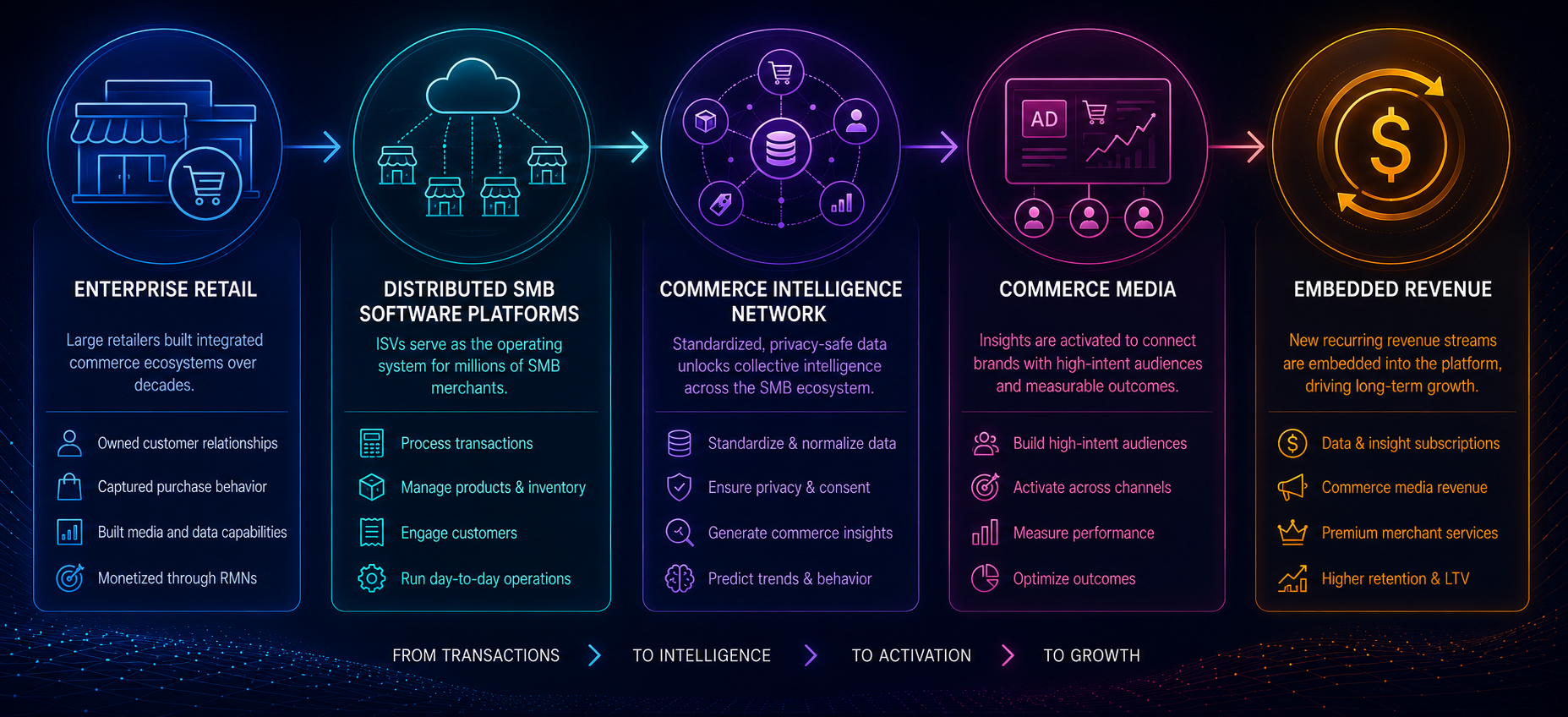
Today, however, a new form of infrastructure is emerging. Independent Software Vendors increasingly function as the operating system for millions of SMB merchants. They process transactions, manage inventory, issue receipts, coordinate customer engagement, organize product catalogs, support payments, and manage day-to-day operations.
Collectively, these platforms now occupy a position remarkably similar to that of enterprise retailers fifteen years ago. The difference is architectural. Instead of one retailer serving millions of customers, thousands of software platforms collectively support millions of merchants.
This distributed model creates a new opportunity: Distributed Commerce Intelligence.
Exhibit 1
The Evolution of Commerce Infrastructure
The Three Dimensions of the Payments-to-Media Evolution
The Payments-to-Media Gateway is not a single product or technology. It represents the convergence of three structural shifts that reinforce one another.
Pillar 1
The Transaction Is Becoming an Intelligence Layer
Historically, payment infrastructure existed to move money — authorization, settlement, reconciliation, reporting. Success was measured through speed, reliability, and transaction volume.
Those capabilities remain foundational. Increasingly, however, they represent only the first layer of value.
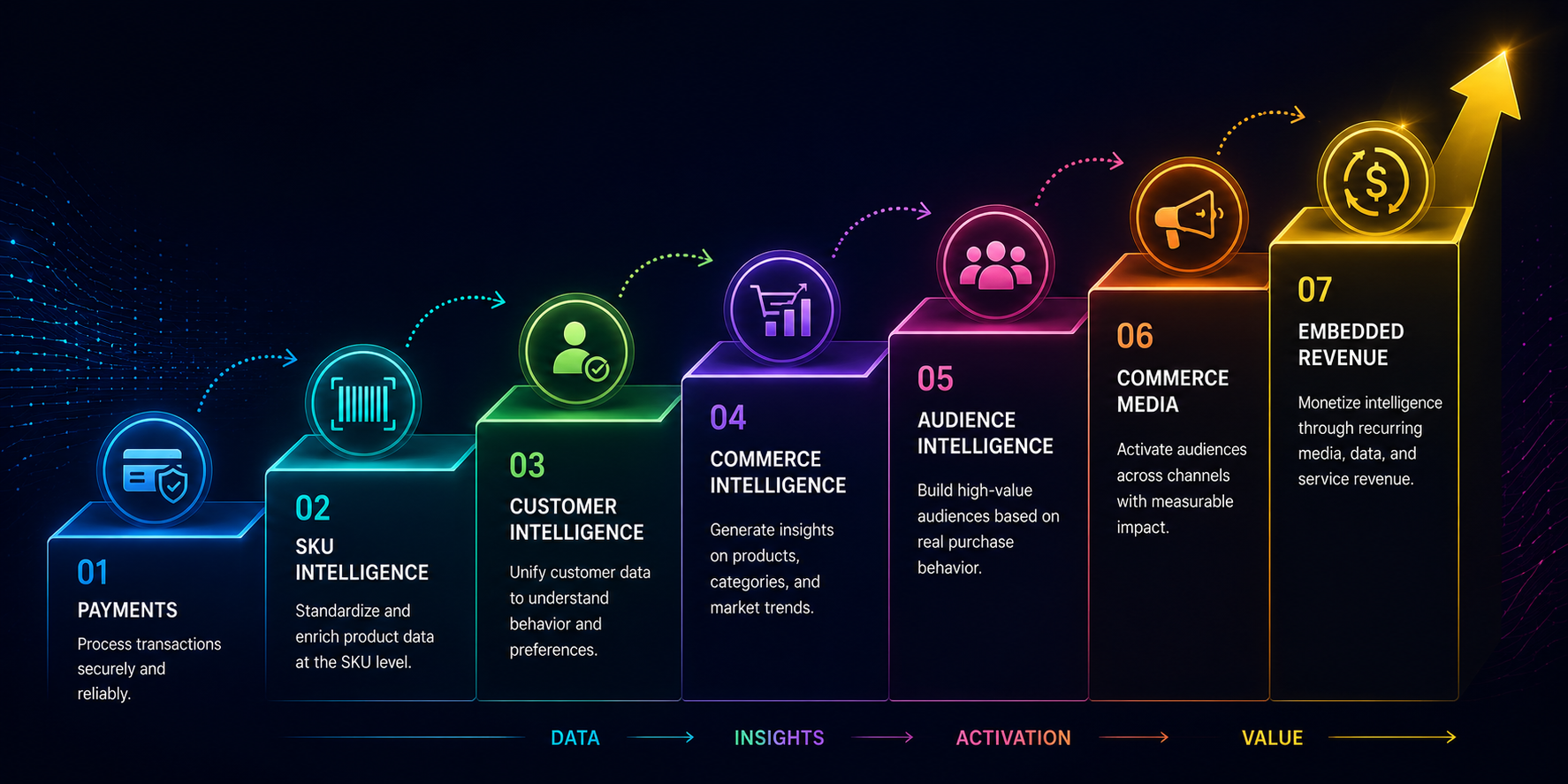
Every transaction simultaneously captures products purchased, purchase sequence, basket composition, purchasing frequency, brand selection, category behavior, timing, and customer preferences. Collectively, these signals describe commerce itself.
As AI-driven decision making expands, structured transaction intelligence becomes significantly more valuable than raw transaction records. This shifts the strategic role of payment infrastructure. Rather than concluding with settlement, the transaction becomes the beginning of an intelligence lifecycle.
Exhibit 2
The Commerce Intelligence Stack
Pillar 2
The Rise of Distributed Commerce Intelligence
Retail Media Networks demonstrated the value of understanding customer purchasing behavior within a single retailer. The next evolution extends beyond individual retailers.
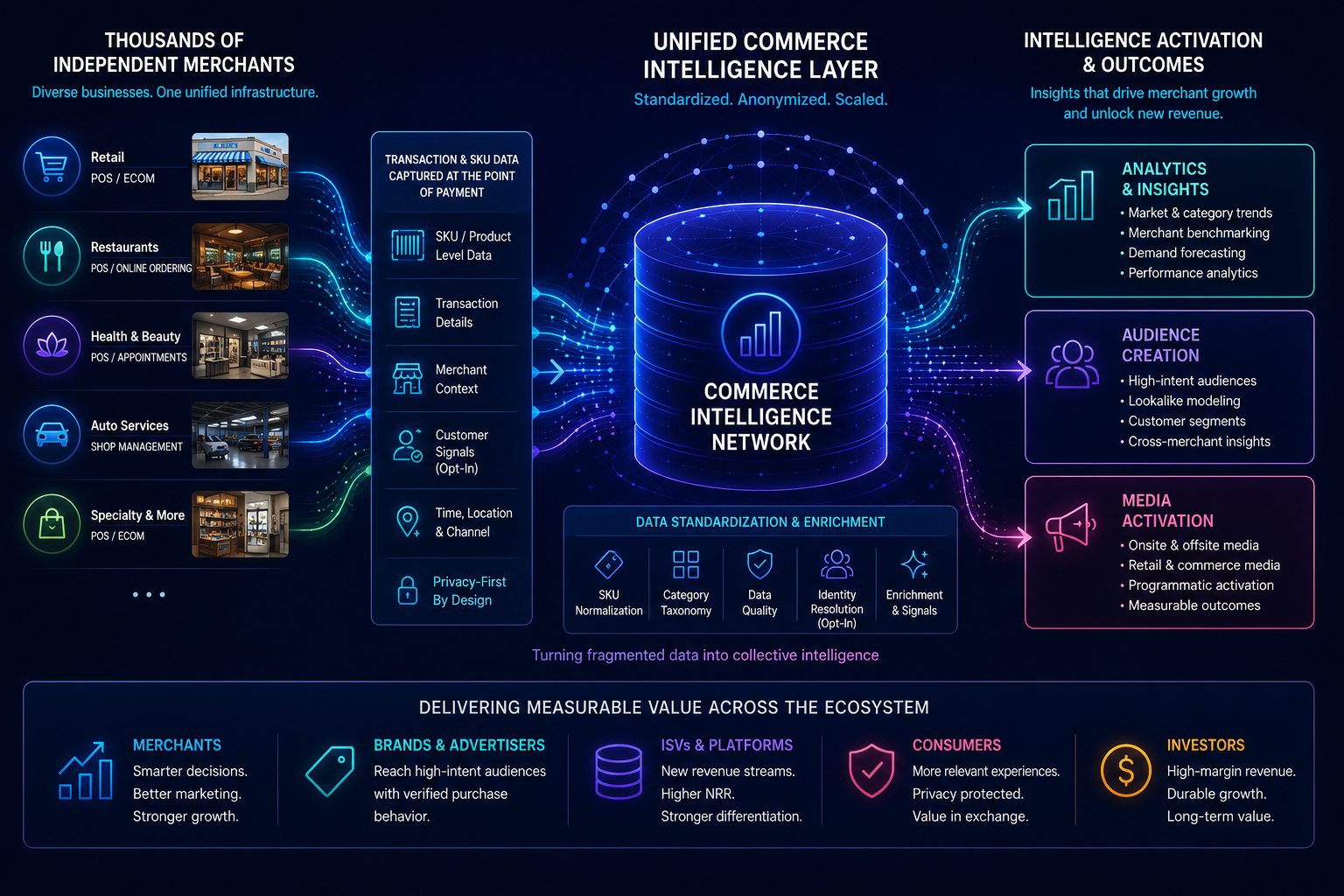
No single SMB merchant possesses sufficient scale to understand broader consumer purchasing behavior. Collectively, however, thousands of merchants create an extraordinarily rich picture of commerce.
When standardized, privacy-protected, and appropriately governed, distributed transaction intelligence begins to reveal regional demand shifts, product substitution, category expansion, brand migration, purchase timing, customer loyalty patterns, and emerging trends.
Importantly, this intelligence becomes more valuable as participation increases. Each merchant contributes incremental understanding while simultaneously benefiting from broader market visibility. This network effect distinguishes distributed commerce intelligence from isolated merchant reporting.
The objective is not replacing Retail Media Networks. It is expanding the universe of merchants capable of participating in commerce intelligence.
Exhibit 3
From Fragmented Merchants to Connected Commerce Intelligence
Pillar 3
Platform Economics Are Moving Up the Value Stack
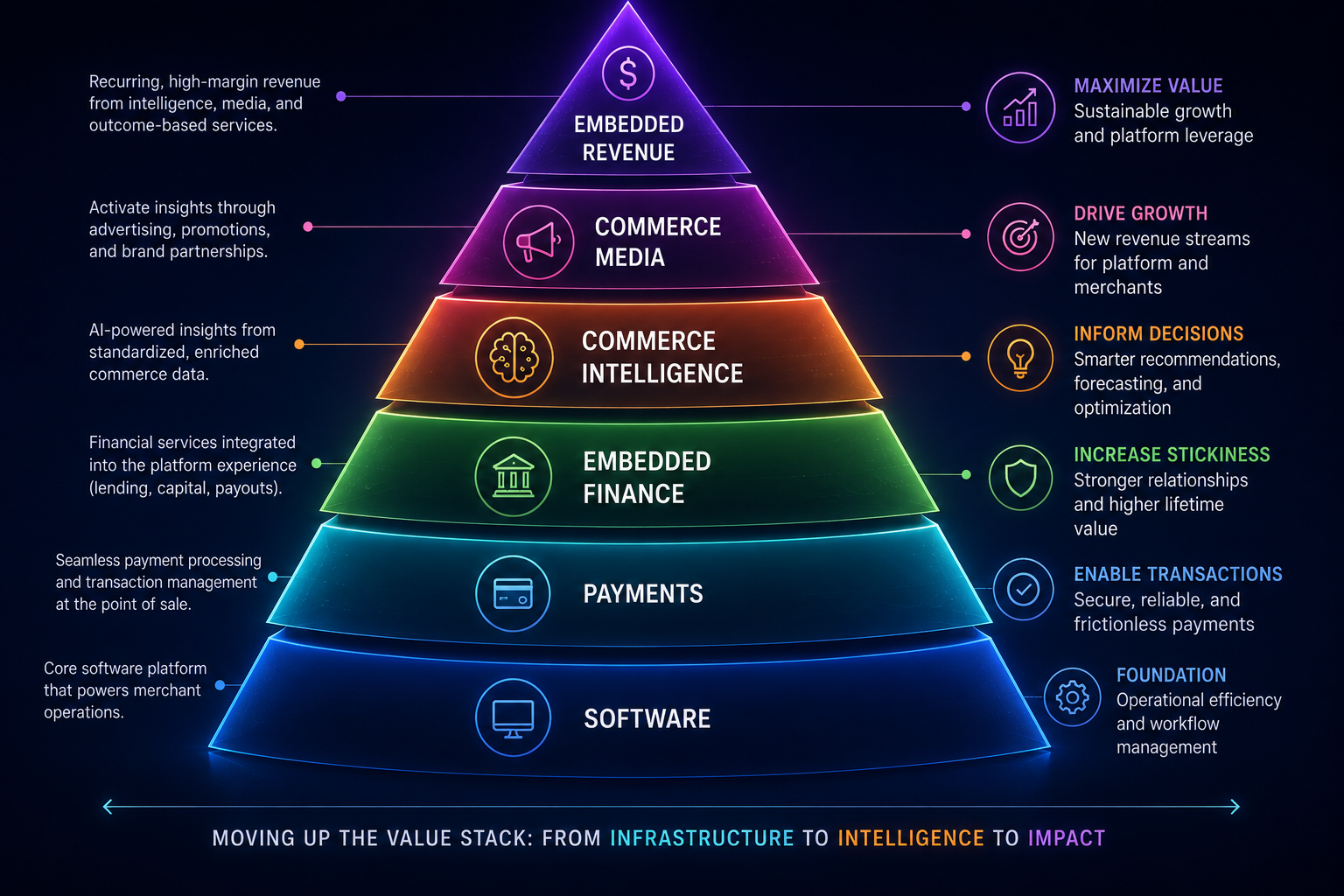
For much of the past decade, software platforms expanded revenue through three primary mechanisms: software subscriptions, payment processing, and embedded financial services. These remain important contributors to platform economics.
Increasingly, however, another layer is emerging: commerce intelligence.
Unlike software subscriptions, commerce intelligence becomes more valuable as participation expands. Unlike payment processing, it is not directly constrained by transaction margin compression. Unlike lending or financial products, it improves merchant outcomes through better decision making.
Examples include customer intelligence, merchant benchmarking, predictive inventory, audience activation, commerce media, measurement services, supplier insights, and AI-powered recommendations.
These capabilities create recurring, high-value services that complement rather than replace existing platform revenue. The economic model shifts from monetizing software access toward monetizing merchant success.
Exhibit 4
The Platform Value Stack
Implications for Industry Incumbents
The Cost of Remaining a Transaction Processor
The competitive environment surrounding payments continues to intensify. Merchant processing fees face sustained pricing pressure. Software differentiation becomes increasingly difficult. Customer acquisition costs continue to rise.
These dynamics collectively compress traditional platform economics. Organizations responding solely through operational efficiency or pricing adjustments risk addressing symptoms rather than structural change.
The larger strategic question is whether transactions remain purely financial events. Increasing evidence suggests they do not.
Platforms capable of transforming transactional activity into standardized commerce intelligence create additional layers of enterprise value without requiring merchants to fundamentally change existing workflows.
Conversely, organizations that continue viewing payment infrastructure primarily as settlement infrastructure risk participating in increasingly commoditized markets.
The distinction is subtle. One processes commerce. The other understands commerce.
Exhibit 5
Two Futures for Platform Economics
| Traditional Platform | Commerce Intelligence Platform |
|---|---|
| Optimizes transaction processing | Optimizes merchant outcomes |
| Generates software revenue | Generates intelligence revenue |
| Measures historical activity | Predicts future opportunities |
| Stores transaction records | Activates commerce intelligence |
| Competes on price | Competes on insight |
Outlook for Platform Leaders
Perspectives from the StitchAI Team
The industry has spent the past twenty years optimizing how transactions move. The next decade will be defined by understanding what those transactions mean.
Every payment captures commercial intent. Every receipt captures purchasing behavior. Every SKU contributes another signal describing how consumers actually buy.
Historically, these signals remained fragmented across individual merchants and disconnected software platforms. Increasingly, they can be standardized, enriched, activated, and transformed into measurable merchant value.
The strategic opportunity is therefore not to replace payment infrastructure. It is to elevate it.
The payment rail becomes the foundation. Commerce intelligence becomes the differentiator. Media activation becomes the growth engine.
Organizations that continue viewing transactions solely as financial events will likely compete in increasingly commoditized markets. Those that recognize transactions as the beginning of an intelligence lifecycle will be positioned to participate in a new generation of platform economics.
Immediate Priorities for Platform Leaders
Executive teams should begin preparing now by focusing on five foundational capabilities:
- Standardize commerce data by improving SKU normalization, product taxonomy, and data quality.
- Build a trusted first-party data foundation through consent management, governance, and privacy-first architecture.
- Invest in commerce intelligence, enriching transaction records with product, customer, and contextual insights that improve decision quality.
- Create activation pathways that translate intelligence into merchant outcomes — analytics, AI recommendations, measurement, and audience activation.
- Develop an ecosystem strategy that connects software, payments, commerce intelligence, and media into a unified value proposition.
The Payments-to-Media Gateway is not a prediction about a single technology or company. It is the logical outcome of several structural trends that are already reshaping commerce.
Software became the operating system for business. Payments became embedded within software. The next phase is that commerce intelligence becomes embedded within payments.
The platforms that recognize this shift earliest will be positioned to create value not only by facilitating commerce, but by helping merchants understand, activate, and grow it.
Closing Perspective
The defining question for platform leaders is no longer:
"How do we process more transactions?"
It is:
"How do we create more value from every transaction we already process?"
The answer increasingly points toward a common destination: the Payments-to-Media Gateway, where transactions evolve from financial events into intelligence assets that power merchant growth, commerce media, and the next generation of platform economics.